| OCR Text |
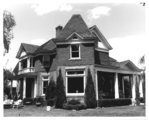
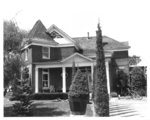
Show Period prehistoric iRnruiRQQ 1600-1699 1700-1799 1800-1899 x 1900- Specific dates Areas off Significance Check and justify below archeoloav-nrehistoric communitv Diannina conservation economics education engineering exploration/settlement industry invention archeology-historic agriculture _X_ architecture art commerce communications Builder/Architect landscape architecture law literature military music philosophy politics/government religion science sculpture social/ humanitarian theater transportation other (specify) not known Statement of Significance (in one paragraph) This house was built in 1901 at a cost of $4,000 for Thomas Austin, a wealthy Lehi livestock rancher. The house draws its significance from its association with Austin and as the best example in Lehi of Victorian domestic architecture.* At a time when eclecticism and irregularity in house design was at a premium, the Austin House projects an asymmetry of massing and mixing of historical details which is truly exceptional. *Utah State Historical Society Architectural Survey, Spring 1980. Thomas Austin was born in England in 1864 and came to Lehi in 1868 with his parents who were converts to The Church of Jesus Christ of Latter-day Saints. His father became a farmer and it seems likely that young Thomas was raised in this type of work. In the 1880s and 90s, both the cattle and the sheep industries became increasingly important commercial enterprises in UtahJ and Thomas Austin became involved in both of them. By the mid-1890s Austin was well established in sheep and cattle.2 in 1896, for example, he opened sheep shearing corrals west of Lehi where he employed 35 men and sheared between 5000 and 6000 sheep a season. 3 Such success allowed Austin to build a large, elaborate house for his family in 1901. Combining decorative elements of several styles into a highly irregualr format, the eclecticism of the Austin House is consistent with the prevailing architectural thinking of the peri od. During the late-nineteenth century, the Queen Anne, Eastlake, and Stick Styles dominated the domestic architecture of Utah.^ These styles were united by a picturesque aesthetic which stressed "highly irregular plans, discontinuous asymmetrically massed forms, and the manipulation of surfaces with varied textures."5 In addition to a preoccupation with visual complexity, this picturesque tradition was by nature highly eclectic, with architects freely choosing among many diverse historical periods for suitable elements of composition and decoration.^ The Austin House seemingly takes both main facets of the design model to their extremes: the floor plan and roof outline of the house are self-consciously asymmetrical and complex (there are few straight lines left intact for the eye to follow), while the mixing of Classical and Queen Anne exterior motifs is both unusual and invigorating. Only the use of masonry walls prevents the attainment of the third architectural principle the texturing of wall surfaces. In all, the Thomas Austin House in Lehi is a fine extant example of Victorian architecture in Utah. |