| OCR Text |
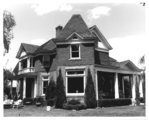
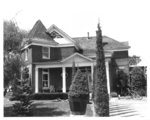
Show 7. Description Condition _X. excellent good fair deteriorated ruins unexposed Check one unaltered JL_ altered Check one X original site moved date Describe the present and original (if known) physical appearance Standard elements of Victorian design suggest that pattern books were a starting point for this house's design, however, the irregularity of massing and unusual combination of various motifs indicate that it is more than likely a unique compositon. Hip and gable roof sections have been combined so that the house has several axes of differing lengths, and an irregular wall surface punctuated by projecting bays and a variety of window types. The west and south walls have both been accented by elaborate porches which make it difficult to ascertain which of the two was intended as the principle facade. A square bay with a steep pyramid roof is set diagonally into the southwest corner separating those two walls. The first floor porch over the west entrance on the north half of the building is topped with a smaller portico. The pediment of the portico is out of proportion with respect to the size of the house. The pediment is supprted on piers of varying dimensions, each of which is topped by a capital. The piers of the first floor porch may not be original, and the porch balustrade has been removed. The piers of the one story porch on the south side too are not original, but have been designed to resemble those on the front porch and are compatible with the design of the house. Its balustrade has also been removed, but the small pediment projecting from the roof over the entry is intact. It is echoed by the small pediment over the second story window of the diagonally set, three part bay. The south door is larger and more elaborate than the one on the west wall, and is flanked by a diamond shaped, and keyhole shaped stained glass window. That accentuation, and the fact that the door opens into a small vestibule suggests that the south entrance was intended as the primary point of entry. ^If that is the case, it is strange that the door on the vest wall has been givn so much emphasis. The mix of elements, and variety of forms of this house have been tied together in several ways. A wide frieze decorated with dentils wraps around the upper edges of the house, and around each porch and pediment, The brick of the first and second stories varies slightly in color, that on the first floor being lighter. Two courses of rough faced brick define the division between the first and second stories, and a projecting course of red sandstone marks the division between the first floor and the foundation. That rough-faced brick has also been used at each of the corners in an alternating header and stretcher pattern. A simple double hung sash window has been used consistently on the second story, and a double hung sash window with a plain transom was used repeatedly on the first floor with the exception of a single sash window with a stained glass transom on the facade of the diagonal bay, and the smaller stained glass windows that flank the south entrance. Alterations include those already mentioned with respect to the porches, the addition of a new roof, and the addition of a set of stairs at the back of the house. The balustrade of the new stairs was designed to approximate the design of the balustrade of the portico on the west wall, and do not greatly affect the original integrity of the building. The other changes too are compatible with the original design. |