| OCR Text |
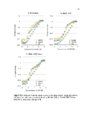
Show 29 was in the binding pocket for PIE7, which is indeed what was observed. However the denaturation curves for both E560K and WT also did not change significantly when compared to the curves of these constructs without PIE7trimer as shown in Figure 2.2. This result was somewhat confusing because previous thermal denaturation experiments have shown that IQN17, when bound to PIE7-trimer, has a higher Tm than it does in the absence of the D-peptide [2]. ! To determine if the high concentration of salt present in the guanidine experiment was potentially masking important electrostatic interactions that contribute to the stability of the PIE7-trimer bound IZN36 trimer, the experiment was repeated with IZN36-WT alone and with bound D-peptide using urea as a denaturant instead of guanidine. Again, no significant difference was observed between WT and WT:PIE7-trimer (data not shown) thus the method was not pursued with the mutant constructs. ! Finally, because previous thermal denaturation studies showed a significant improvement in the stability of IQN17 when bound to PIE7-trimer [2], thermal denaturation measured by CD was attempted with IZN36-WT in the presence of 4 M urea. Two problems were encountered with this experiment that led to the abandonment of this approach. First, even at 90°C in 4 M urea, we were unable to see complete unfolding of IZN36-WT. Secondly, the thermal denaturation of IZN36-WT appeared irreversible even with 7 minute equilibration times between temperature changes (data not shown). Thermal melts of IZN36 in the presence of guanidine also proved irreversible (data not shown). |