| Title |
William LaMonte Robison, Murray, Utah: an interview by Becky B. Lloyd, July 1, 2004: Saving the Legacy tape no. 675 |
| Alternative Title |
William LaMonte Robison, Saving the legacy: an oral history of Utah's World War II veterans, ACCN 2070, American West Center, University of Utah |
| Creator |
Robison, William LaMonte, 1920-2011 |
| Contributor |
Lloyd, Becky B.; University of Utah. American West Center |
| Publisher |
Digitized by J. Willard Marriott Library, University of Utah |
| Date |
2004-07-01 |
| Date Digital |
2015-12-16 |
| Access Rights |
I acknowledge and agree that all information I obtain as a result of accessing any oral history provided by the University of Utah's Marriott Library shall be used only for historical or scholarly or academic research purposes, and not for commercial purposes. I understand that any other use of the materials is not authorized by the University of Utah and may exceed the scope of permission granted to the University of Utah by the interviewer or interviewee. I may request permission for other uses, in writing to Special Collections at the Marriott Library, which the University of Utah may choose grant, in its sole discretion. I agree to defend, indemnify and hold the University of Utah and its Marriott Library harmless for and against any actions or claims that relate to my improper use of materials provided by the University of Utah. |
| Spatial Coverage |
Philippines; Japan |
| Subject |
Robison, William LaMonte, 1920-2011--Interviews; Veterans--United States--Biography; World War, 1939-1945--Personal narratives, American; World War, 1939-1945--Campaigns--Pacific Area--Personal narratives, American |
| Keywords |
Radar observation; Army Air Corps; Rescue operations; USS Indianapolis |
| Description |
Transcript (48 pages) of an interview by Becky B. Lloyd with Richard W. Johnson on June 3, 2004. From tape number 654 in the "Saving the Legacy" Oral History Project |
| Collection Number and Name |
Accn2070, Saving the Legacy oral history project, 2001-2010 |
| Abstract |
Mr. Robison was born May 31, 1920, in Salt Lake City, Utah. His father farmed in Rupert, Idaho. Mont worked as a bookkeeper before enlisting in the Army Air Corps in March 1944. He received basic training at Sheppard Field, Texas, and attended radio operator mechanics school at Scott Field, Illinois. He was sent to Biloxi, Mississippi, to train with PBYs and shipped to California to crew up with a rescue squad. He was then shipped to Luzon, Philippines. He discusses his experiences, inluding dropping lifeboats to survivors of the USS Indianapolis and flying with bombers to provide rescue, when necessary. He participated in occupation duty in Japan before his discharge in 1945. Mr. Robison became a licensed CPA and co-owned the firm of Robison, Hill & Company for over fifty years. Interviewed by Becky Lloyd. 30 pages. |
| Type |
Text |
| Genre |
oral histories (literary works) |
| Format |
application/pdf |
| Extent |
30 pages |
| Language |
eng |
| Rights |
 |
| Scanning Technician |
Mazi Rakhsha |
| Conversion Specifications |
Original scanned with Kirtas 2400 and saved as 400 ppi uncompressed TIFF. PDF generated by Adobe Acrobat Pro X for CONTENTdm display |
| ARK |
ark:/87278/s6jx0h00 |
| Topic |
Personal narratives--American; Veterans; World War (1939-1945) |
| Setname |
uum_slohp |
| ID |
1033188 |
| Reference URL |
https://collections.lib.utah.edu/ark:/87278/s6jx0h00 |
| Title |
Page 22 |
| Format |
application/pdf |
| Setname |
uum_slohp |
| ID |
1033179 |
| OCR Text |
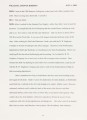
Show WILLIAM LAMO TE ROBI 0 MON: I'm sorry. I don t remember what I was going to say. My memory is gone. I don t have a good memory. BEC: I sometimes have that problem too. MON: Well, I've had a stroke and so it's because of that. BEC: Oh, really? I never would have guessed. J 1 2 04 fmy pr bl m . MON: Yes, I've had two strokes and my memory has been wiped out, most of it. BEC: Wow, I think you're doing exceptionally well. MON: Maybe the real old stuff I remember, but my wife complains about me not remembering day to day what I'm supposed to do. With all the assignments that I get, I don't seem to remember what I'm supposed to do (laughs). BEC: That's funny. So you continued doing that until... MON: Then, of course, we were on Luzon when Japan surrendered. That was after the bomb had been dropped on Hiroshima. Then we flew up to Ieshima and stayed there for a few days and then flew into Japan. We went to Atsuki Air base in Atsuki, Japan. It was really a cadet training center for the Japanese Air Force. We took over their barracks. We were waiting there to be mustered out and sent home. We were considered occupational forces of course, but I don't remember our having a lot of duties. The sad thing was that not too long after we got into our barracks, the cook burned the barracks down one night. All of our belongings were destroyed. After that, we were living in hangers instead of barracks. It was a terrible situation. All of our records were destroyed, too. So the records of our time in the Air Force and what our accomplishments were were all were destroyed in the fire. So, you know, we got so many points for being there so long and the things that we did, the air sea rescues that we 22 |
| Reference URL |
https://collections.lib.utah.edu/ark:/87278/s6jx0h00/1033179 |