| Title |
Ray H. Wheeler, Lewiston, Utah: an interview by Winston P. Erickson, March 21, 2000: Saving the legacy tape no. 79 |
| Alternative Title |
Ray H. Wheeler, Saving the legacy: an oral history of Utah's World War II veterans, ACCN 2070, American West Center, University of Utah |
| Creator |
Wheeler, Ray H., 1921- |
| Contributor |
Erickson, Winston P., 1943-; University of Utah. American West Center |
| Publisher |
Digitized by J. Willard Marriott Library, University of Utah |
| Date |
2000-03-21 |
| Date Digital |
2015-09-16 |
| Access Rights |
I acknowledge and agree that all information I obtain as a result of accessing any oral history provided by the University of Utah's Marriott Library shall be used only for historical or scholarly or academic research purposes, and not for commercial purposes. I understand that any other use of the materials is not authorized by the University of Utah and may exceed the scope of permission granted to the University of Utah by the interviewer or interviewee. I may request permission for other uses, in writing to Special Collections at the Marriott Library, which the University of Utah may choose grant, in its sole discretion. I agree to defend, indemnify and hold the University of Utah and its Marriott Library harmless for and against any actions or claims that relate to my improper use of materials provided by the University of Utah. |
| Spatial Coverage |
Guam; Philippines; Japan; Cache County, Utah, United States |
| Subject |
Wheeler, Ray H., 1921- --Interviews; World War, 1939-1945--Personal narratives, American; World War, 1939-1945--Campaigns--Pacific Area--Personal narratives, American; Merchant mariners--Biography; Veterans--Utah--Biography; Atomic bomb--History |
| Keywords |
Merchant Marines; Atomic bomb; Radiation sickness; Subic Bay; Tinian; Guam; Iwo Jima; Okinawa |
| Description |
Transcript (37 pages) of an interview by Winston P. Erickson with Ray H. Wheeler on March 21, 2000. This is from tape number 79 in the "Saving the Legacy Oral History Project |
| Collection Number and Name |
Accn2070, Saving the Legacy oral history project, 2001-2010 |
| Abstract |
Ray Wheeler was born in 1926 in Lewiston, Utah. He joined the Merchant Marines in 1944, and served aboard the W. W. McCracken, the Commodore, and the John S. Bassett in the Pacific. He discusses the radiation sickness he suffered after the use of atomic weapons, as well as the treatment of Merchant Marines by the government after the end of the war. 37 pages. |
| Type |
Text |
| Genre |
oral histories (literary works) |
| Format |
application/pdf |
| Extent |
37 pages |
| Language |
eng |
| Rights |
 |
| Scanning Technician |
Mazi Rakhsha |
| Conversion Specifications |
Original scanned with Kirtas 2400 and saved as 400 ppi uncompressed TIFF. PDF generated by Adobe Acrobat Pro X for CONTENTdm display |
| ARK |
ark:/87278/s63z05wt |
| Topic |
Personal narratives--American; Veterans; World War (1939-1945); Merchant mariners; Atomic bomb |
| Setname |
uum_slohp |
| ID |
1023147 |
| Reference URL |
https://collections.lib.utah.edu/ark:/87278/s63z05wt |
| Title |
Page 19 |
| Format |
application/pdf |
| Setname |
uum_slohp |
| ID |
1023126 |
| OCR Text |
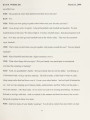
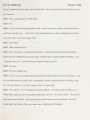
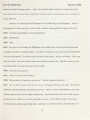
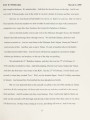
Show RAY H. WHEELER March 21 2000 didn't find out anymore about that cruiser the Indianapolis. The cruiser Indianapoli had th two atomic bombs welded on the deck and nobody knew anything about it. They made Pearl Harbor in 73 hours. That's 2,000 miles. It's a record. They took on more fuel and made Tinian on the 26th of July, and discharged those two atomic bombs at Tinian on the 26th of July, and pulled out to go back to the Philippines. Well, a day-and-a half out a Japanese submarine torpedoed them, the cruiser the Indianapolis. I've got a book on it. It's on the films. They weren't zigzagging. The law was to zigzag so you didn't get a true course. Well, this Japanese sunk five torpedos in the Indianapolis. It rolled over and sank in twenty minutes. WIN: Really? RAY: It had 1,185 men. Hand me that book to show him. There were 1,185 men. And they didn't get an SOS off. It's the biggest tragedy the navy has ever seen. Anyway, they picked them up three days later. They picked up less than 300-well, 235 men. The sharks and the barracuda ate them all. And the captain survived. But, if they had torpedoed that ship two days before they delivered the atomic bomb, we wouldn't have had the atomic bomb, and this world would have been a different place to live in. WIN: It certainly would have prolonged the war, wouldn't it have? RAY: Well, it's hard to say. We would have been living in Alaska, and I'll tell you why. When the war ended Truman went over there to Potsdam. And he knew we had that bomb. And he told Stalin that. And Stalin didn't even raise his eyes. If we hadn't demonstrated that bomb-the Russians had 500 divisions in Europe, and Japan had another three million men under arms. And 17 |
| Reference URL |
https://collections.lib.utah.edu/ark:/87278/s63z05wt/1023126 |