| Title |
Leslie Eric Teasdale, Sandy, Utah: an interview by Winston Erickson, August 16, 2001: Saving the legacy tape no. 285 and 286 |
| Alternative Title |
Leslie Teasdale, Saving the legacy: an oral history of Utah's World War II veterans, ACCN 2070, American West Center, University of Utah |
| Creator |
Teasdale, Les (Leslie Eric), 1920-2006 |
| Contributor |
Erickson, Winston P., 1943-; University of Utah. American West Center |
| Publisher |
Digitized by J. Willard Marriott Library, University of Utah |
| Date |
2001-08-16 |
| Date Digital |
2015-09-16 |
| Access Rights |
I acknowledge and agree that all information I obtain as a result of accessing any oral history provided by the University of Utah's Marriott Library shall be used only for historical or scholarly or academic research purposes, and not for commercial purposes. I understand that any other use of the materials is not authorized by the University of Utah and may exceed the scope of permission granted to the University of Utah by the interviewer or interviewee. I may request permission for other uses, in writing to Special Collections at the Marriott Library, which the University of Utah may choose grant, in its sole discretion. I agree to defend, indemnify and hold the University of Utah and its Marriott Library harmless for and against any actions or claims that relate to my improper use of materials provided by the University of Utah. |
| Spatial Coverage |
England, United Kingdom; Egypt; Italy; Germany |
| Subject |
Teasdale, Les (Leslie Eric), 1920-2006--Interviews; World War, 1939-1945--Personal narratives, British; Veterans--Utah--Biography; Prisoners of war--Great Britain; Prisoners of war--Italy; Prisoners of war--Germany |
| Keywords |
POWs |
| Description |
Transcript (55 pages) of an interview by Winston P. Erickson with Leslie Eric Teasdale on August 16, 2001. This is from tape numbers 285 and 286 in the "Saving the Legacy Oral History Project |
| Collection Number and Name |
Accn2070, Saving the Legacy oral history project, 2001-2010 |
| Abstract |
Leslie Teasdale (b. 1920) was born in a suburb of London. He recalls his boyhood and education prior to getting a job with a passenger liner. He was conscripted into the Royal Artillery Coastal Defense Regiment and later served in Egypt, where he was taken prisoner in June 1942. He was subsequently transferred to prisoner of war camps in Italy and Germany. His camp was liberated by the Americans in January of 1945. 55 pages. |
| Type |
Text |
| Genre |
oral histories (literary works) |
| Format |
application/pdf |
| Extent |
55 pages |
| Language |
eng |
| Rights |
 |
| Scanning Technician |
Mazi Rakhsha |
| Conversion Specifications |
Original scanned with Kirtas 2400 and saved as 400 ppi uncompressed TIFF. PDF generated by Adobe Acrobat Pro X for CONTENTdm display |
| ARK |
ark:/87278/s6q54nvb |
| Topic |
Personal narratives--British; Veterans; World War (1939-1945); Prisoners of war |
| Setname |
uum_slohp |
| ID |
1022828 |
| Reference URL |
https://collections.lib.utah.edu/ark:/87278/s6q54nvb |
| Title |
Page 42 |
| Format |
application/pdf |
| Setname |
uum_slohp |
| ID |
1022812 |
| OCR Text |
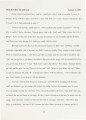
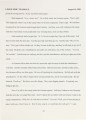
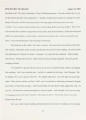
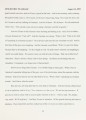
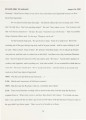
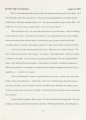
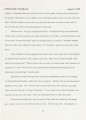
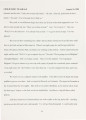
Show L LIE ERI TE DALE ugu t 16, 2001 M rden urrey. he was waiting for the same bus as what I was and she had this guy with h r. I said, Oh have you got the new boyfriend with you?" o she said "Well, as a matter of fact we're married." I said, 'Oh congratulations." And I've never seen her from that day to this. We were engaged for about three years. But, you know, that was the thing. Some of the guys in the camp were informed- they heard all sorts of stories when they were feeling really low, and somebody would write and say their wife was carrying on with somebody else. And they'd try and hang themselves. We had one or two guys that committed suicide. The Germans used to get us out in parade and count us. Every morning we would be counted. And if there was one missing they'd leave us out there. We'd have to stand out there until they found somebody in the toilet that was hanging. They would keep on until they found where the other person was. Other things that happened in the camp: We had a latrine at the bottom of the camp. It was about six foot deep, and about 20 foot long. And it had a big pole over the top of it raised up about four feet, or something. But when you went to the toilet you'd have to sit on this pole and do what you wanted to do, and then jump off. It was pretty precarious. If anybody was caught committing a crime in the camp-stealing, or anything like that-he was shoved in the latrine and held under. And then he'd be taken out and put straight into the hospital. They'd clean him up, they'd shower him down, and run him into the hospital; something else that a lot of people don't know. That was the discipline in the camp. I, myself- I've got to admit that I was caught stealing. I was caught stealing some gloves 40 |
| Reference URL |
https://collections.lib.utah.edu/ark:/87278/s6q54nvb/1022812 |