| Title |
Nathan J. Fullmer, Salt Lake City, Utah: an interview by Luke Kelly, August 11, 2001: Saving the legacy tape no. 282 |
| Alternative Title |
Nathan J. Fullmer, Saving the legacy: an oral history of Utah's World War II veterans, ACCN 2070, American West Center, University of Utah |
| Creator |
Fullmer, Nathan J., 1925- |
| Contributor |
Kelly, Luke; University of Utah. American West Center |
| Publisher |
Digitized by J. Willard Marriott Library, University of Utah |
| Date |
2001-08-01 |
| Date Digital |
2015-09-16 |
| Access Rights |
I acknowledge and agree that all information I obtain as a result of accessing any oral history provided by the University of Utah's Marriott Library shall be used only for historical or scholarly or academic research purposes, and not for commercial purposes. I understand that any other use of the materials is not authorized by the University of Utah and may exceed the scope of permission granted to the University of Utah by the interviewer or interviewee. I may request permission for other uses, in writing to Special Collections at the Marriott Library, which the University of Utah may choose grant, in its sole discretion. I agree to defend, indemnify and hold the University of Utah and its Marriott Library harmless for and against any actions or claims that relate to my improper use of materials provided by the University of Utah. |
| Spatial Coverage |
Germany |
| Subject |
Fullmer, Nathan J., 1925- --Interviews; World War, 1939-1945--Personal narratives, American; Veterans--Utah--Biography; World War, 1939-1945--Military operations, American; World War, 1939-1945--Campaigns--Europe, Northern--Personal narratives, American |
| Keywords |
69th Infantry Division; Company C, 272nd Infantry Regiment; Battle Axe Regiment; Sharpshooters |
| Description |
Transcript (34 pages) of an interview by Luke Kelly with Nathan J. Fullmer on August 2, 2001. This is from tape number 282 in the "Saving the Legacy Oral History Project |
| Collection Number and Name |
Accn2070, Saving the Legacy oral history project, 2001-2010 |
| Abstract |
Fullmer (b. 1925) discusses serving with the 69th Infantry Division, in Company C of the 272nd Infantry Regiment (the so-called "Battle Axe" Regiment.") He was assigned to a 12-man rifle squad and classified as a sharpshooter. By the time he boarded a troop ship headed for England he was a PFC. He describes moving through Germany with his regiment, being on patrol, and meeting up with the Russian army at the Elbe River. After V-E day he was transferred into Ordnance, where he was responsible for captured enemy material. Fullmer returned home on the Santa Maria, and was discharged as a Staff Sergeant. 34 pages. |
| Type |
Text |
| Genre |
oral histories (literary works) |
| Format |
application/pdf |
| Extent |
34 pages |
| Language |
eng |
| Rights |
 |
| Scanning Technician |
Mazi Rakhsha |
| Conversion Specifications |
Original scanned with Kirtas 2400 and saved as 400 ppi uncompressed TIFF. PDF generated by Adobe Acrobat Pro X for CONTENTdm display |
| ARK |
ark:/87278/s66h6gn4 |
| Topic |
Personal narratives--American; Veterans; World War (1939-1945) |
| Setname |
uum_slohp |
| ID |
1021171 |
| Reference URL |
https://collections.lib.utah.edu/ark:/87278/s66h6gn4 |
| Title |
Page 16 |
| Format |
application/pdf |
| Setname |
uum_slohp |
| ID |
1021151 |
| OCR Text |
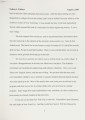
Show athan J. Fullmer mall but a high rise. It was sitting on th hill. nd headquarters with the platoon leader th lieut nant and a tl t 0 th My squad-it was like a beer tavern. It was down on a nic ra th along the bank of the Rhine. It had been used by Germans for that purpo . nt . ri ht bunks in it, straw ticks. It was dry. One of the squads was on a flat bottom boat that had been grounded, and they had nice facilities there. I mean it wasn't floating. It was that facility where I spent my 20th birthday, March 24th 1945. I was a little shocked to find out the guys in the squad had a pot going as to whether I would make it to 20. And if the pot was big enough, you know, they might have taken it into their own hands. There was some gunfire. Everybody on the West Bank thought that it was their duty to shoot at anything that was floating down that river. We were upstream of the bridge, and if you'd see a speck out there, why, that's a German frogman going down trying to blow up the bridge, you know-anywhere from .45 caliber pistols to the M-1 's. I don't think they turned any machine guns on it, or antitank guns. But that was a little hard on the troops on the East bank because those bullets would ricochet off the water. We finally were told to quit shooting. But morning and night, just at dawn and just at dusk, one German plane would make a pass at that bridge. And the antiaircraft guns up and down the river just-you know, they never did get him, but he never got the bridge either. They got so much in the way of armor and supplies and trucks going across that that old railroad bridge collapsed. But by this time the engineers had put two steel 15 |
| Reference URL |
https://collections.lib.utah.edu/ark:/87278/s66h6gn4/1021151 |