| Title |
Dr. Victor Kassel, Interviews with Jews in Utah, Accn 998 |
| Alternative Title |
Accn 998, Interviews with Jews in Utah, Dr. Victor Kassel |
| Description |
Transcript (109 pages) of interviews by Leslie Kelen with Victor Kassel on August 10, 1987 and September 17, 1987 for the Interviews with Jews in Utah Oral History Project. |
| Creator |
Hertz, Eugene, 1910-2002 |
| Contributor |
Kelen, Leslie G., 1949-; Oral History Institute |
| Publisher |
Digitized by J. Willard Marriott Library, University of Utah |
| Date |
1987-08-10; 1987-09-17 |
| Date Digital |
2015-07-06 |
| Access Rights |
I acknowledge and agree that all information I obtain as a result of accessing any oral history provided by the University of Utah's Marriott Library shall be used only for historical or scholarly or academic research purposes, and not for commercial purposes. I understand that any other use of the materials is not authorized by the University of Utah and may exceed the scope of permission granted to the University of Utah by the interviewer or interviewee. I may request permission for other uses, in writing to Special Collections at the Marriott Library, which the University of Utah may choose grant, in its sole discretion. I agree to defend, indemnify and hold the University of Utah and its Marriott Library harmless for and against any actions or claims that relate to my improper use of materials provided by the University of Utah. |
| Spatial Coverage |
Brooklyn, Kings County, New York, United States, http://sws.geonames.org/5110302 |
| Subject |
Jews, American--Utah--Interviews; Hertz, Eugene, 1910-2002--Interviews; World War, 1939-1945--Personal narratives, American; Jews--Social life and customs |
| Abstract |
When first interviewed by Leslie Kelen in 1978, Victor Kassel (b. 1920) recalled his childhood in Brooklyn, the anti-Semitism he experienced, his experiences in the military during World War II, and his entry into the field of geriatrics. During the later interviews, Kassel speaks at length about geriatrics, discusses Medicaid and Medicare, the development of nursing homes, talks about his view of the Jewish community in Salt Lake, and his habit of making "outlandish" or controversial statements in order to make people think. He also offers his opinion on the physical and spiritual health of the Jewish community. 109 pages. |
| Type |
Text |
| Genre |
oral histories (literary works) |
| Format |
application/pdf |
| Extent |
109 pages |
| Language |
eng |
| Rights |
 |
| Is Part of |
Interviews with Jews in Utah collection, 1982-1988, http://archiveswest.orbiscascade.org/ark:/80444/xv70657/ |
| Scanning Technician |
Niko Amaya; Halima Noor |
| Conversion Specifications |
Original scanned with Kirtas 2400 and saved as 400 ppi uncompressed TIFF. PDF generated by Adobe Acrobat Pro X for CONTENTdm display |
| ARK |
ark:/87278/s6zp61v0 |
| Topic |
Jews, American; Jews--Social life and customs; World War (1939-1945) |
| Setname |
uum_iju |
| ID |
901791 |
| Reference URL |
https://collections.lib.utah.edu/ark:/87278/s6zp61v0 |
| Title |
Page 61 |
| Format |
application/pdf |
| Setname |
uum_iju |
| ID |
901741 |
| OCR Text |
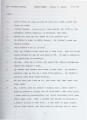
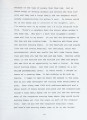
Show encounter. Did a lot of wide reading for it. L: During the civil rights time period did you comment on that. V: Dealt with civil rights, dealt with the Vietnam war and the Korean war, Russia. Everything that came along. In fact I'm sure, the station was obligated to tape the show and hold it for a week or ten days or· something and I'm sure at home I have copies of all the tapes, a whole bunch of tapes. I always said that when I die I was going to ~~~ up a tape machine in the cemetery with a whole list of subjects and if you wanted something all you do is press it in and my tape will come out and talk about that particular subject. Yes, I became infamous. I became notoriouus. I became known all over the country for my two-way talk radio and then in the community here they also got involved. L: This sides going to run out. In just two seconds I'm going to turn it. SIDE 4 V: So, on the basis of that paper "Polygamy after Sixty." The first telegram I got was from a woman in San Diego, who said, "We Jews have enough trouble. Did you have to start this?" Oh, I would make outlandish statements. For example, I have to give an annual talk in Miami, the city of Miami on nursing homes. The end of the talk, when there was talk uality about sex/in the nursing homes, because I'd written, I'd done the first national conference on sexual in the aged. Funded by the public health service in Denver from the time 60 |
| Reference URL |
https://collections.lib.utah.edu/ark:/87278/s6zp61v0/901741 |