| OCR Text |
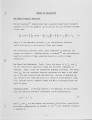
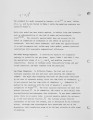
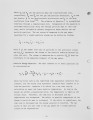
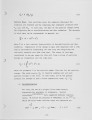
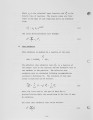
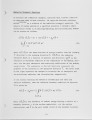
Show The terras on the right-hand side of Equation 19 represent contributions to the outgoing intensity due to emission from the surface and reflection of incoming radiation. Simply, Equations 18 and 19 are replaced by a discrete set of equations for a finite number of ordinate directions. Integrals are replaced by a quadrature summed over the ordinate directions. The resultant equations are integrated over each control volume and solved by a point~by-point iterative scheme. The transport equation requires absorption and scattering cross sections for particles and an absorption cross section for the gas mixture. For particles, correlations for absorption and scattering cross sections have been specified for each of the particle types: coal, char, and ash. The absorption cross section for the gas mixture can be specified in several ways. One option is to initialize values directly from input. Another option is to use correlations in the program of (25) emissivity charts established by Hottel and his co-workers. The source term for the energy equation can be found from the divergence of Equation 18 as follows: Sh = K J l&& dfi' " 4K°T4 (20) ft'=4TT Solution Method Gas and solid phase equations outlined in the preceding sections dealing with gas phase transport equations and particle transport equations are solved. An axisymmetric geometry is subdivided into control volumes. Gas phase conservation equations are solved for each control volume subject to the boundary conditions for mass, momentum, and energy. Gas phase conservation equations are solved line-by-line; that is, all variables are solved at a line at fixed-z before proceeding to a new line. Particle phase equations are solved by Lagrangian methods in which the motion of individual particle streams are tracked through the combustor. A radiation solution is found over the whole r-z field by an -13- |