| OCR Text |
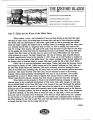
Show THE HISTORY BLAZER I IVEI~~ OSF UTAH'S PAST FROM THE I I Utah State Historical Societv I 300 Rio Gra~ lde Salt Lake City. ZTT 84101 ( 801) 533- 3500 FAX ( 801) 533- 3503 Green River Presbyterian Church THE TRANSCONTINENTAL RAILROAD BROUGHT a flock of Protestant evangelists to Utah eager to convert the predominantly Mormon citizenry to mainstream Christianity. They quickly learned that camp meetings attracted fewer patrons than church schools. So, wherever local school terms were haphazard, books in short supply, and teachers poorly trained ( which included most everywhere in the territory), Mormon and non- Mormon parents alike enrolled their children in the alternative Methodist, Presbyterian, or Episcopalian grade and secondary schools. Many a non- Mormon church built in early Utah served a double purpose as a schoolhouse. But by the end of the century Utah saw a decline in Protestant evangelistic fervor. One contributing factor was the Manifesto officially ending the Mormons' practice of plural marriage- a reform Protestants had eagerly worked toward. Another factor was the very success of the Protestant schools in preparing the way for a public school system mandated by the Utah Territorial Legislature in the 1890s. A third factor was the Panic of 1893 followed by nearly a decade of severe depression. This greatly affected the ability of eastern congregations to support Utah and other missions fmancially. Thus a new phase of Utah Protestantism began: the era of community churches. The Green River Presbyterian Church represents this phase. The wooden Victorian Gothic chapel was built in 1906- 7 just as Green River, Emery County, was becoming a distinct community. A settlement had actually existed at this favorable crossing of the Green River since 1879, when a mail route was begun between Ouray, Colorado, and Salina in Sevier County, Utah. Within four years the Denver & Rio Grande had laid its line through the town. In about 1895 residents began calling their settlement Green River. Due largely to the railroad but also to a budding peach industry, Green River saw considerable growth between 1900 and 1910. Citizens elected their first town council, platted a new townsite, officially incorporated, and built a metal- truss wagon bridge over the river. The Reverend J. K. McGillivray established the town's first church: Green River Presbyterian. But non- Mormons were a minority in almost every Utah town, and Green River was no exception. To assemble a congregation the little church had to draw its 29 members from eight denominations. This was not uncommon for Utah Pro testant bodies. Usually they maintained loose ties with a sponsoring sect that provided financial and pastoral support. In Green River, McGillivray moved on to be replaced by the Reverend McLain W. Davis who was the prime mover behind a chapel. The church project received wide support. A local development company, Green River ( more) Land and Townsite, donated five lots totaling just under an acre at 134 West Third Avenue. The Utah Presbytery's Board of Church Erection provided a $ 1,000 grant, probably in the form of a mortgage. Local members raised $ 2,200 through suppers and bake sales, cash donations, and labor subscriptions. The total cost came to $ 4,500. For a fee of $ 125 the Salt Lake f m of Ware & Treganza Architects drew up plans for the edifice. Characterized as Late Gothic Revival, their design stipulated a stone foundation and a cross- shaped wooden superstructure with a tower surrounded by four battlements at the fore of the projecting wing. By summer 1907 members were using the building, and it was dedicated that October. For the next 50 years, one full- time Presbyterian minister or another ministered to the Green River congregation. But by 1958 the Utah Presbytery could no longer provide such support, and the Green River congregation officially reorganized as a community church. In 1963 they added four classrooms and a storage room to their building. In 1986 they painted the church white with gold trim and replaced the roof. Green River Presbyterian Church survives as a beautifid example of a turn- of- the- century Protestant community church in Utah. Source: Nomination form, National Register of Historic Places, Presewation Office files, Utah Division of State History. THE HISTORYBL AZERi s produced by the Utah State Historical Society and funded in part by a grant from the Utah Statehood Centennial Commission. For more information about the Historical Society telephone 533- 3500. 961103 ( BB) |