| OCR Text |
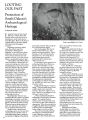
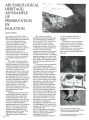
Show 62 LOOTING OUR PAST Protection of South Dakota's Archaeological Heritage by Frank H. Adams Inside the homes of many South Dakotans, artifacts which date from the region's early history lay on mantlepieces, knick- knack shelves, and coffee tables. These are the fruits of a popular hobby in the state: digging and collecting archaeological curiosities. Sometimes mounted in display cases, the artifacts range from arrowheads to Indian pottery fragments, to rare whole pots, glasses and bottles, and even human bones. To the owners, they have> not only personal value but, in the case of some objects, considerable monetary value. " The trouble is, that if these objects came from federal or Indian land, the owners are breaking a law which carries penalties of up to a year's imprisonment and a $ 10,000 fine if they are arrested and convicted," says Steve Ruple, archaeologist for the Historical Preservation Center, Vermillion, South Dakota. Archaeologists refer to these people as pot hunters, looters, and sometimes as collectors. The law is the Federal Antiquities Act of 1979, and is intended to protect " objects of antiquity" which are located on " public lands and Indian lands," according to the text of the law. The objects the law refers to must be at least 100 years old, and are defined as " any material remains of past human life or activities which are of archaeological interest." The philosophy of the law runs something like this: artifacts on federal land belong to the public, and if they are dug up they should be analyzed and placed in museums for public viewing. When pot hunters dig up artifacts for their own collections or for trade or sale, it interferes with this process. Artifacts need to be protected, archaeologists point out, because their commercial value and their value as collectables makes them so attractive that people are digging archaeological * sites in large numbers. When people do this it has tremendous impact. State Archaeologist Bob Alex of Sturgis, South Dakota, says, " Pot hunters are destroying history. When they dig a site they're destroying the information in it; It's a little akin to book burning; destroying the information before anyone gets a chance to look at it." Pot hunting is bad as opposed to an archaeological dig, Steve Ruple says, because " any disturbance to a site destroys the context of inter- related facts, such as soil stains, plant pollen, and variations which wouldn't have been there if people hadn't lived there. In the ground, this relationship only has meaning if the sites are dug and interpreted by a skillful archaeologist." By analyzing these relationships, archaeologists can tell how old artifacts are, probable uses, and a host of facts about the culture. Ruple regards artifacts as resources, saying, " The entire public doesn't have a right to destroy non- renewable resources. They have a right to enjoy them. People have an obligation to do their part to protect them." A Pierre resident described how widespread pot hunting is in the state's capital: " It's a popular Sunday afternoon sport for many people to go out to the river and collect artifacts in summertime. When the water gets low enough in the Oahe reservoir people go to old Fort Sulley and submerged Indian villages to look for artifacts." Since the land around and under the reservoir is owned by the Army Corps of Engineers, people who participate in this " Sunday afternoon Looter's pit in bluff at Crow Creek sport" are actually in violation of the Antiquities Act. While many people who do this are ignorant of the law, and don't collect on a wide scale, others know about the law and have resorted to extreme measures to pillage historical sites. There have been reports by Tim Nowak, archaeologist for the Corps of Engineers, that one pot hunter has used dynamite in his search for earthen pots, arrowheads, and bones. Once, Nowak says, " There was a guy from California over by Old Fort Sulley when the water was down. He was using a backhoe to dig while looking for artifacts." Further north by Mobridge, an area rich in archaeological sites, pot hunters have been busy. At a prehistoric Indian village site, one archaeologist says, " Another archaeologist and I were there, and there were holes dug by looters which were so deep that if you were down in them, you couldn't get out without a ladder. There were so many holes it looked like a battlefield." While archaeologists would rather have the Antiquities Act serve as a deterrent to looters, seeking arrests and convictions of destructive looters is sounding more practical to the Council of South Dakota Archaeologists. Law enforcement officers and archaeologists hope convictions will deter looting where mere posting of the law has failed. Although South Dakota Archaeologists are committed to reducing theft of antiquities, they realize this is easier said than done. They face a problem of protecting archaeological resources in South Dakota's 77,000 square miles with a small force. " If you're talking about any real enforcement of the Antiquities Act, you've got to have a case like Crow Creek," says an FBI agent in Pierre. The Crow Creek case he refers to involved the theft and vandalism of some 44 skeletons in one of North America's most important archaeological sites. The site is the remains of a fortified Indian Village south of Fort Thompson on the Missouri River. Over Memorial Day weekend in 1978, a group of South Dakota archaeologists stumbled across a huge mass of human bones protruding from the eroding river bank. Excavation and analysis of the bones revealed the remains of nearly 500 people who had been massacred in 1325 and dumped into the defense ditch surrounding their village. But before the archaeologists returned to the site to excavate it, someone climbed the bluff and chopped about 18 cubic feet of human remains from the bank. This upset the archaeologists who were there to learn about a past culture, and it disgusted and angered Sioux Indians living in the Crow Creek Indian Reservation. " I don't understand the idea of going out and looking for bones and pots, making it a regular practice. What would people think if we went into Chamberlain digging up graves, looking for gold teeth and jewelry?" Vice- Chairman of the Crow Creek Sioux Tribe Leroy Thompson says. Archaeologists reported the theft to the Tribal Police in Fort Thompson, and to the FBI in Pierre. Both law Looter's hole at Lake Mitchell site enforcement agencies investigated the theft, but evidence was sparse and inconclusive. " It's pretty tough to prove if material comes from federal or Indian land. If trace elements are on the pots or bones, maybe chemical or other laboratory forensic tests could be used to prove where they came from," says the FBI agent. The agent says he's heard of people going to old Fort Sulley in the Oahe Reservoir to hunt for pots and bottles. With regard to protecting antiquities along the Missouri River, he says, " I wouldn't mind setting up a river patrol myself." Even if an archaeologist sees someone looting material from federal lands there can be difficulties. " One time I was inspecting some sites along the Missouri River," says Adrian Hannus, Archaeologist for South Dakota State University, " when I saw a man and a boy digging up the bank, screening the soil for pots and arrowheads. I told them that this was against the law and we argued for a while." When Hannus walked in to the local sheriffs house to report this, he saw the mantlepiece and walls of the room were sprinkled with Indian pottery. Hanuth Dakota in Vermillion suspect Blair is the person who vandalized the human remains at the Crow Creek Massacre Site. But Blair says he has never been there. However, both the Tribal Police at Fort Thompson and the Army Corps of Engineers report that Blair was on the site with his pickup, which is registered in his wife's name. And Dale Lundquist, Park Manager for the Corps of Engineers at Chamberlain r says Blair claims to have been digging at the Crow Creek Site. Blair also claims he has never sold any pottery or tried to, which is also against the law. But Doris Schneider, former owner of the Art Potpourri in Mitchell, has a different story. " He had Indian pottery from the Southwest, from New Mexico, and some from Chamberlain. He wanted to sell some of it here on consignment. I asked him to check with an archaeologist to set a value. But he was reluctant to do so; he said people in the scientific field weren't in favor of his work." Archaeologists feel that aside from monus says he just gave up and made small talk. " We need to inform law enforcement officers that there's a serious looting problem and we want them to enforce the laws and protect these sites. If the laws have reasonable penalties, I hope they're enforced," says Darrell Fulmer, President of the Council of South Dakota Archaeologists. In the South Dakota Archaeological Society, people who enjoy the thrill of discovery when they unearth artifacts can pursue their hobby and contribute to the information we have about past settlements, according to Steve Ruple. Former Brookings Judge Lyle Cheever says, " I'm an amateur archaeologist. I will not be involved in a dig unless it's supervised by a professional. I'm not a pot hunter, and have no personal collection. I want to ensure, discover, preserve, and record the information for the public. " If people have had training and record what they find, and make their information available to the public, they aren't being destructive. Then they contribute to the general fund of knowledge about South Dakota." Cheever said he would like to convince pot hunters that by digging they're destroying information and gaining little in the process. " In our area there aren't that many whole pots and they don't have that much economic value," he says. As part of a program to interest people in amateur archaeology, Lynn Alex of Sturgis trains people to dig correctly to recover the artifacts and get the information from a site. And members of the South Dakota Archaeology Society tour sites and participate in digs. |