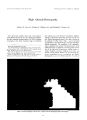
| OCR Text |
Show Journal of Neitro- Ophllmlmohgy 19( 3): IR2- IH5, 1999. & 1999 Lippincoll Williams & Wilkins, Inc., Philadelphia Idiopathic Intracranial Hypertension A Case Report With Optic Nerve Histopathology Hilary C. Horgan, Robert M. McFadzean, and William R. Lee We present the clinical and pathologic findings in an atypical case of idiopathic intracranial hypertension. A 51 - year- old man had headaches, visual deterioration, papilledema, and deafness. Ncuroimaging was normal, and cerebrospinal fluid pressure monitoring confirmed increased intracranial pressure. The patient was treated with a vcntriculo- peritoneal shunt. Histopathology revealed grossly atrophic optic nerves with almost complete axonal loss. The prelaminar portion of the optic nerves was thickened by gliosis and hyalinized capillaries, which have not been described previously. Key Words: Idiopathic intracranial hypertension- Visual loss- Ventriculo- peritoneal shunt- Axonal loss. Idiopathic intracranial hypertension ( IIH) is a disease primarily of obese women in their second to fourth decades of life ( 1). It is characterized by increased intracranial pressure, without evidence of an intracranial mass, enlargement of the ventricles, or abnormal composition of the cerebrospinal fluid ( CSF). The most significant complication of IIH is permanent visual loss caused by prolonged papilledema with secondary optic atrophy. Visual impairment is demonstrable in up to 90% of patients, but most of these have only minor defects ( 2). The cause is unknown and because the disorder is not life threatening, there is little histopathologic data available. One previous paper reports severe optic atrophy with 80% to 90% axonal dropout that was more marked in the peripheral area of each optic nerve ( 3,4). We report the histopathologic findings in the optic nerves in an atypical case of IIH. CASE SUMMARY A 51 - year- old man was referred for investigation of headaches, deafness, and deteriorating vision. He gave a Manuscript received March 3, 1999; accepted March 16, 1999. From the Department of Neuro- ophthalmology ( HCH, RMM), Institute of Neurological Sciences, Southern General Hospital, and Department of Pathology ( WRL), University of Glasgow, Glasgow, Scotland. Address correspondence and reprint requests to Dr. Robert M. McFadzean, Department of Neuro- ophthalmology, Institute of Neurological Sciences, Southern General Hospital, 1345 Govan Road, Glasgow, G51 4TF, Scotland. 2- to 3- year history of throbbing, frontal headaches that were worse on awakening. His vision had deteriorated gradually in his right eye during the previous year. His hearing impairment was initially episodic but recently had become constant. On examination, best corrected Snellen visual acuity for right eye was CF and left eye 6/ 9. There was a right relative afferent pupillary defect. Ocular motility was normal. The right visual field to confrontation showed a large centro- caecal scotoma and generalized constriction. The left Bjerrum central visual field showed enlargement of the blind spot and generalized peripheral constriction with a 3- mm white target. Dilated fundoscopy showed moderate bilateral papilledema with developing pallor of the right optic disc. Full blood count, erythrocyte sedimentation rate, urea, and electrolytes were normal. A computerized tomography ( CT) scan enhanced with contrast was normal and audiologic investigations revealed a bilateral, degenerative sensorineural deafness. A lumbar puncture showed clear CSF, under high pressure with < 5 nucleated cells/ mm", protein 0.35 g/ 1, and glucose 6.3 mmol/ 1. No organisms were grown on culture. The patient unfortunately defaulted from follow- up and did not return to the clinic for 8 months when his corrected Snellen visual acuity had deteriorated further to right eye: no perception of light, and left eye: 6/ 24. A relative afferent pupillary defect was present on the right. Both optic discs were diffusely atrophic ( more marked in the right eye), and the left visual field had become reduced to a small temporal island. Another CT scan and bilateral carotid angiography showed no abnormality, in particular no evidence of a venous sinus occlusion. Intracranial pressure monitoring was performed using an indwelling ventricular catheter and confirmed persistent elevation of the mean intracranial pressure higher than 35 mm Hg. The CSF had < 5 nucleated cells/ mm3, with normal protein and glucose. No organisms were grown on culture. A diagnosis of atypical ITH was made and the patient was commenced on 4 mg dexamethasone 6 hourly. Unfortunately, he developed glycosuria and a fasting blood glucose confirmed diabetes mellitus. A ventriculo-peritoneal ( V- P) shunt was inserted and his headaches settled. Postoperatively, his visual acuity and fields remained unchanged. J 82 ATYPICAL IDIOPATHIC INTRACRANIAL HYPERTENSION 183 Nineteen months later, his headaches returned because of blockage of the V- P shunt, and a revision was carried out. Thereafter, the patient was followed up for another 10 years, during which time his visual acuity and fields were unchanged. A plain CT tomoscan carried out at final follow- up showed normal- sized ventricles with effective drainage by the shunt. Unfortunately, the patient died suddenly, 11 years after presentation. At autopsy, the cause of death was found to be myocardial infarction. PATHOLOGY The globes were removed at autopsy within 24 hours of death and fixed in 2% buffered glutaraldehyde before paraffin embedding. Macroscopic examination of both eyes revealed normal dimensions 24 x 23 x 23 mm. The attached optic nerve and surrounding sheath in each specimen measured 15 mm in length and 8 mm in diameter. On section, both optic nerves were atrophic ( 3 mm diameter) and the dilated subarachnoid space was filled with loose fine white tissue strands ( Fig. 1). On the nasal side, the subarachnoid space appeared more distended ( 3 mm in horizontal alignment) than on the temporal side, where the dura was more in line with the edge of the scleral canal ( Fig. 2). The prelaminar part of the optic discs were atrophic and projected forward. Microscopic examination revealed a normal anterior segment, lens, and vitreous in each eye. Serial sections ( 10 jxm) were taken from the blocks and optic nerves and stained with conventional stains: Haematoxylin and Eosin ( H& E), Periodic acid Schiff ( PAS), Prussian Blue, Loyez, and Bodian. The following immunohistochemical reactions were applied: SI00, neuronal specific enolase ( NSE), and neurofilaments. Apart from the peripapillary retina ( see later), the retinal photoreceptor layer, the retinal pigment epithelium, and the choroid were normal. Throughout the retina the ganglion cell layer was atrophic and this change was most pronounced at the fovea. It was possible to identify a few surviving axons in the nerve fiber layer of the retina in each eye using immu-nohistochemistry. In both eyes, the prelaminar part of the optic nerve was thickened by glial tissue that contained numerous hyalinized capillaries ( Fig. 3). The peripapillary retina was atrophic and the photoreceptor layer was replaced by glial cells. This was accompanied by patchy atrophy of the retinal pigment epithelium and choroidal fibrosis, although the choroidal vessels were patent ( Fig. 4). Horizontal longitudinal sections through the optic nerves of both eyes revealed atrophy that was more extensive on the temporal side ( Fig. 5). Axons were identified within the atrophic nerve bundles on the nasal side in the left eye but were not identified with certainty in the right eye. In transverse sections through the optic nerves, myelinated axons were identified on the nasal side of the axial part of the left optic nerve but were unidentified in the right optic nerve. The trabeculae in the subarachnoid space were of normal thickness. NEUROPATHOLOGIC FINDINGS On gross examination the fixed brain weighed 1,480 grams. There was no evidence of tentorial or tonsillar FIG. 1. Coronal section across the optic nerve of the left eye shows an atrophic nerve surrounded by a dilated subarachnoid space ( x12). J Neiiro- Ophllmlmol. Vol. 19, No. .<, 1999 184 H. C. FIG. 2. Axial section of the left eye shows the nasal projection of the subarachnoid space ( x12). herniation. A defect in the lateral aspect of the right parietal lobe was seen through which the V- P shunt protruded. The ventricles were of normal size. The occipital cortex appeared normal. Histologic examination showed a thickened dura FIG. 3. Numerous hyalinized vessels embedded in glial tissue ( arrows) are present in the prelaminar part of the optic nerve ( H & E x 200). ETAL. FIG. 4. In each eye, there is pronounced outer retinal atrophy ( arrows) in the peripapillary retina ( H & E x200). along the convexity with collections of chronic inflammatory cells in a relatively acellular collagen matrix. The sagittal sinus showed features of longstanding occlusion with partial recanalization and the occlusion appeared organized with collections of chronic inflammatory cells. The appearances were those of pachymeningitis, which presumably was the cause of the longstanding occlusion of the sagittal sinus, but the cause of this pachymeningitis was unclear. The V- P catheter tip was blocked by ingrowth of glial cells and capillaries, cuffed by lymphocytes. The neuropathologic examination was carried out by Professor D. I. Graham and Dr. J. A. R. Nicoll. DISCUSSION We report the histopathologic changes in the optic nerves in an atypical patient with IIH. Although the patient had features typical of IIH ( headaches, papilledema, visual field loss, and increased intracranial pressure), his age and sex were atypical of this condition. Substantial visual deterioration is also unusual in IIH. FIG. 5. Axial section through the left optic nerve shows a dilated subarachnoid space and atrophy of the temporal bundles of the optic nerve ( arrow). The prelaminar part of the nerve is thickened ( H & E x 32). ./ Nnim- OplilliahiKil, Vol. 19. No. J, 1999 ATYPICAL IDIOPATHIC INTRACRANIAL HYPERTENSION 185 According to one author ( 5), only 10% of IIH patients develop bilateral severe permanent visual loss. Progressive sensorineural deafness is not a feature of IIH, although tinnitus is common. This patient had diabetes mellitus but no evidence of hypertension or renal impairment, which are sometimes associated with IIH ( 6). There were no other neurologic signs apart from deafness, despite the unusual neuropathologic findings at postmortem. No previous imaging studies, including contrast- enhanced CT scanning and carotid angiography, had suggested a sagittal sinus thrombosis. The patient was seen 7 months before his death when his visual acuities and fields remained unchanged, with no recurrence of headaches. It was unusual to find blockage of the ventriculo- peritoneal shunt at postmortem, in the absence of signs and symptoms of increased intracranial pressure before his death. Possibly, the initial pathology was the sagittal sinus thrombosis with a secondary increase in intracranial pressure. However, bilateral carotid angiography carried out at the time of presentation did not show any evidence of thrombosis. His symptoms settled with insertion of a V- P shunt, which at a later stage, became blocked without any subsequent increase in intracranial pressure because of recanaliza-tion of the sagittal sinus demonstrated at autopsy. Thus, it appears that the sagittal sinus thrombosis was a secondary event, which subsequently resolved spontaneously. The presence of numerous hyalinized capillaries in the prelaminar part of the optic nerve is difficult to explain. Endothelial proliferation of the capillaries and smaller vessels has been previously described along with proliferation of neuroglia in longstanding papilledema ( 7,8). The most plausible explanation is that there was capillary dilation when the disc was oedematous. If there was endothelial ischemia at this stage, the integrity of the capillary monolayer may have been compromised, resulting in plasma leakage and multilayering of the basement membrane with endothelial repopulation. Contraction of the glial cells could possibly have accentuated the number of capillaries to give a false impression of previous proliferation of vessels within the nerve head. Nonetheless, reactionary neovascularization cannot be totally discounted. This case highlights the dilated subarachnoid space around the optic nerve, which is more marked on the nasal than the temporal side ( Fig. 2). In a healthy eye, the subarachnoid space is widest anteriorly and with a temporally directed scleral canal wider on the nasal side than the temporal side ( 9). This finding is interesting because most optic nerve sheath decompression procedures are performed with a medial approach, which is easier to perform and has fewer potential complications ( 10). In addition, decompression of the more dilated, medial subarachnoid space may create a better fistula leading to more rapid and complete resolution of papilledema. Only one other pathologic study of IIH has been reported in the literature ( 3,6). Our findings of significant axonal loss in the periphery of the left optic nerve arc in keeping with this previous report. The few remaining axons that were seen in the left eye corresponded well with the patient's remaining small temporal field of vision in that eye. The myelinated axons were only seen in the axial and nasal areas of the left optic nerve, with almost total loss of axons in the more peripheral parts of the nerve. The right eye had no identifiably myelinated axons correlating with no perception of light in this eye. It appears that the most central nerve fibers were the most protected from the effects of increased intracranial pressure ( 4). These small centrally placed axons arc less subject to mechanical forces and ischemia than more peripherally placed axons. Perhaps the greater distension of the nasal than the temporal subarachnoid space protects the nasal optic nerve axons and temporal visual field from the extreme effects of increased intracranial pressure. REFERENCES 1. Miller NR. Walsh and Hoyl's Clinical Neitro- ophthalmologv. 5th cd. Baltimore: Williams & Wilkins, 1998: 524. 2. Eggenbcrgcr ER, Miller NR, Vitalc S. Lumboperiloneal shunt for the treatment of pseudotumor cerebri. Neurology 1996: 46: 1524- 30. 3. Tsai JC, Petrovich MS, Sadun AA. Hislopalhological and ultra-structural examination of optic nerve sheath decompression. Br .1 Ophthalmol 1995: 79: 182- 5. 4. Gu XZ, Tsai JC, Wurdeman A, Wall M, Foote T, Sadun AA. Pattern of axonal loss in longstanding papilledema due to idiopathic intracranial hypertension. Cttrr Eye Res 1995: 14( 3): 173- 80. 5. Corbell J. I, Savino P. I, Thonpson HS, el al. Visual loss in pseudotumor cerebri: follow- up of 57 patients from five to 41 years and a profile of 14 patients with permanent severe visual loss. Arch Neurol 1982; 39: 461- 74. 6. Guy J, Johnson PK, Corbett JJ, Day AL, Glascr JS. Treatment of visual loss in pseudotumor cerebri associated with uremia. Neurology 1990; 40: 28- 32. 7. Samuels B. Hislopathology of papilledema. Am J Ophthalmol 1938; 21: 1242- 58. 8. Paton L, Holmes G. The pathology of papilledema. A histological study of 60 years. Brain 191 I ; 33: 389- 432. 9. Bron A, Tripathi R. Wolffs Anatomy of the Eye and Orbit. V/ Illh ed. London: Chapman and Hall, 1997: 515. 10. Kellner JL. Optic nerve sheath decompression. Arch Ophthalmol 1988; 106: 1365- 8. ./ Neuiv- Ophlhalmnl, Vol. 19, No. J. 1999 |