| OCR Text |
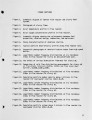
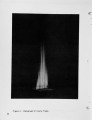
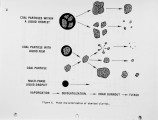
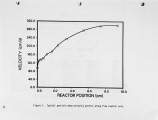
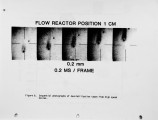
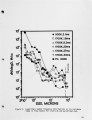
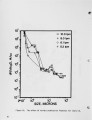
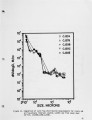
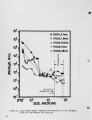
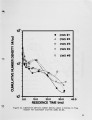
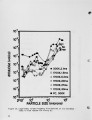
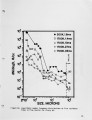
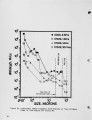
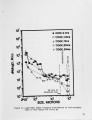
Show RMS velocity spread observed in the reactor is typically less than 20% for all conditions. In addition to an average residence time determination for each size distribution, these velocity measurements allow evaluation of the absolute particle number density at each point in the flow. Since we assume that all particles have the same median velocity, this generates a maximum error of about 20% in the relative number density between the largest and smallest particles. Corroborating measurements of the velocity have also been obtained with the Hycam camera. The transit-timing meaurements are based on 2000 data points for each measurement and mean values are reproducable within 2% for different runs. This variation is indicative of the flow reactor feed stability, since the transit-timing technique has a precision of better than 0.5% at these low flow velocities. Ignition Phenomena Luminous emission occurs within 1-2 mm after passing through the methane-air flame front. Spectroscopic measurements show that this rapid onset of luminosity in the flame appears to derive from sodium-based additives which give a strong sodium emission. A more reliable indication of particle ignition is based on initiation of particle devolatilization which can be observed from the high speed movies. Figure 8 shows a black and white still photograph of this mechanism, with conditions indicated as shown on the photo. These results for slurry #2 show features very similar to previous movies of pulverized coal combustion taken by other workers at Sandia (McLean et al., 1981). At ignition a large cloud of material is formed around the slurried particle and in this case stripped from the particle because of the differential gas-particle velocity. The position at which significant devolatilization occurs is about 1-1.5 cm corresponding to a residence time of about 7-10 milliseconds. Further work is required to quantify these results for a range of reaction conditions and for other slurry fuels. General Features of Measured Particle Size Distributions For the various slurry mixtures a sequence of particle number and volume frequency distributions has been obtained at increasing reactor position in the flow reactor. Figure 9 shows the log-frequency distribution at several axial positions (residence times) in the flow reactor for slurry fuel #1 along with a comparison distribution for a typical power plant grind of a bituminous pulverized coal (labeled PC). The primary purpose of showing the pulverized coal result is to provide a more familiar reference size distribution for comparison with the significantly different distribution characteristics of the slurry fuels. No attempt was made to match total mass flowrates of the slurry and pulverized coal; (the total mass flowrate of the slurry is a factor of three higher than the pulverized coal). The primary comparison point for this discussion is the distribution shape. Several general features of this figure and subsequent frequency distributions in other figures are discussed in the following. The measured size range is from 0.3 - 120 microns, with a small measurement gap between about 2.0 to 3.0 microns. This gap is a consequence of the limited dynamic range for each of the two illumination beams used to cover the wide particle size range (Holve et al., 1981). A rather large 9 |