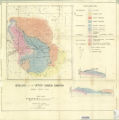
| OCR Text |
Show GBQK30Y OF THE UPFHH OGtEN CJHKXff , WEBER COUNT*, UTAH by Yves Eriksson A t h e s i s submitted t o the f a c u l t y of the U n i v e r s i t y of Utah i n p a r t i a l f u l f i l l m e nt of the r e q u i r e m e n t s for the degree of Master of Science Department of Geology U n i v e r s i t y of Utah J u n e , I960 . L I B R A RY U N I V E R S I T Y O F U T AH This Thesis for the M« 3 . degree by Yves £ r i k s s on has been approved by Reader, S u p e r v i s o r y Committee Head, Kajor Department 4 4 0 9 5 4 ABSTRACT Ogden Canyon i s l o c a t e d Immediately e a s t of Ogden, Utah, and t r a v a r s s s the n o r t h c e n t r a l Wasatch Mountains t o Ogden V a l l e y . The formations exposed in the Upper Ogden Canyon a r e . o v e r t h r u s t ^ r o t e r o - z o i c beds; t h e Devonian J e f f e r s o n dolomite, subdivided i n t o t h e Hyrum and Beirdneau members; t h e M i s s i s s i p p i a n Madison l i m e s t o n e , Deseret l i m e s t o n e , and Humbug f o r m a t i o n ; and t h e T e r t i a r y Knight conglomerate and Norwood t u f f. Unconformities are r e c o g n i z e d between t h e Beirdneau member of t h e J e f f e r s o n and t h e Kadison l i m e s t o n e , and between the Madison and the j e s e r e t l i m e s t o n e . An emergent a r e a t o the n o r t h w e s t a t the end of Madison d e p o s i t i o n i s proposed. S e v e r a l n o r t h - s o u t h t r e n d i n g normal f a u l t s of small displacement, p r o b a b l y of laramide age, cut t h e rocks a t t h e head of Ogden Canyon. The we3t s i d e of Ogden Valley i s marked by a n o r t h w e s t e r l y t r e n d i n g normal f a u l t of the Basin and Range system. P r o t e r o z o i c rocks r e s t a c r o s s t h e beveled edges of the Paleozoic f o r m a t i o n s on both s i d e s of Ogden Canyon. This i s t h e Willard t h r u s t, and problems of i t s mode of emplacement and d i r e c t i o n of movement are d i s c u s s e d . ACKNCWI£DGS"1SNTS The w r i t e r wishes t o thank Dr. A. J . ^ a r d l e y , who o r i g i n a l ly s u g g e s t e d the problem and s u p e r v i s e d the t h e s i s work; Dr. W. Lee S t o k e s, who a s s i s t e d with f o s s i l i d e n t i f i c a t i o n and t h e problem of s t r a t i g r a p h y, Dr. D. J . J o n e s , for h i s advice on s e d i m e n t a t i o n , Dr. Norman C. Williams f o r guidance in p r e p a r i n g the m a n u s c r i p t , Walter S a d l i c k for suggestions on s t r a t i g r a p h i c c o r r e l a t i o n s , and J im F i t z g e r a l d for a s s i s t a n c e in measuring s t r a t i g r a p h i c s e c t i o n s . The w r i t e r is a l s o g r a t e f u l t o the Standard Oil Company of C a l i f o r n i a for the loan of a e r i a l p h o t o g r a p h s. i i TABL3 OF 0CWTENT8 Pago ABSTRACT i ACKNOWLSDaSHKHTS ii INTRODUCTION Purpose and F i e l d Work. • 1 Location and A c c e s s i b i l i t y 1 Topography and Drainage . . . . . .. Previous Geologic Work U t i l i z a t i o n of Land 5 STRATIGRAPHY General S t a t e m e n t . . . . . 4 Late PreCambrian Rocks 4 W i l l a r d Thrust Matamorphic Rocks. 4 D e s c r i p t i o n • 4 C o r r e l a t i o n 5 Theories of D e p o s i t i o n and Orogeny • . • • • 5 Devonian System • • 5 J e f f « r s o n Formation 5 D i v i s i o n s i n Ogden Canyon 5 Hyrum ( ? ) Dolomite 6 nomenclature Problems of the Three Forks Formation (Beirdneau) • 7 Beirdneau Member . . . . . . . . . 8 Devonian Outcrops i n Nearby Areas 10 H i a t u s e s and Unconformities 11 Unconformity Above t h e Beirdneau in Logan Quadrangle. . . . . . . 12 Unconformity Above t h e Beirdneau a t Ogden Canyon 13 Paleogeography and Geologic H i s t o r y . . . . . 14 M i s s i 8 8 i p p i a n System 16 Madison Limestone 16 Major U n i t s , L i t h o l o g y , and Bedding . . . . 16 P a l e o n t o l o g y 17 Basal Unconformity . • 17 C o r r e l a t i o n with Surrounding A r e a s . . . . . 17 Unconformity a t Top of Madison 18 Deaeret Limestone. . . . . . . . . . 19 Bedding and L i t h o l o g y 1? C o r r e l a t i o n . 20 Phosphate Zone 20 D e s e r e t Limestone "Pinch Out" . . . . . . . 21 Humbug Formation • 21 Bedding and L i t h o l o g y . . . . . . . . . . . 21 Basal Contact ..... 22 Basal Humbug B r e c c i a s . 25 P e t r o g r a p h y « 2 5 i i i Page Depos i t i o n a l ISnvironment 22 C o r r e l a t i o n With Surrounding Areas. T e r t i a r y . . Knight (?) Conglomerate Fo /K 3 v Tuff . . . . 24 24 24 25 Recent Alluvium. 25 STRUCTURE P r i n c i p a l S t r u c t u r e s in Ogden Canyon, A t t i t u d e of Bedding Ogden Canyon nZn Fold d a s t - West Folds » . Thrust F a u l t s , Normal F a u l ts W i l l a r d Thrust Local S t r u c t u re Movement Along Thrust Plane . . Problem of Shanghai F a u l t . . • D i r e c t i o n of T h r u s t i ng "Z- Fold Drag S t r u c t u r e s . . . . C o r r e l a t i o n With Cither T h r u s t s. Age of Thrusting G r a v i t a t i o n a l Gliding Ogden Valley Graben GiQMORPHOLGGY Upper Ogden Canyon Weber Valley 3urface B o n n e v i l l e Terraces • . 26 26 76 27 27 27 OA 25 29 7A rA 52• 52 . . . 'A IB 3CON0MIC GEOLOGY Shanghai No. 1 Mine P r o s p e c t F i t s a t the Base of the Madison Limestone. Phosphate Road Building Aggregate * * . • • . 56 ?7 STRATIGRAPHIC SACTIONS Hyrum Member of the J e f f e r s o n 5^ Beirdneau Member of the J e f f e r s o n 40 Deseret Limestone 44 Humbug ( P a r t i a l S e c t i o n along Fineview R e s e r v o i r ) . . 45 Humbug ( P a r t i a l S e c t i o n along Wheeler Canyon). . . . 46 BIBLIOGRAPHY P1AT2S AID ILLUSTRATIONS 52 57 ?7 OAKLEY SCALE: l AAPPROX. 8 MILES QKAMAS F i g . I . I n d e x Map of t h e U p p e r O g d e n C a n y o n a r ea INTRODUCTION Purpose and Field Work The p r e s e n t work was u n d e r t a k e n t o g a i n i n f o r m a t i o n on the s t r u c t u r e and s t r a t i g r a p h y on t h e upper Ogden Canyon. Field work was s t a r t e d in t h e f a l l of 195<3» and continued through the s p r i n g and summer of 1959* Geological i n f o r m a t i o n was p l o t t e d on a e r i a l photos (Scale 1/20,000) of t h e U. 3 . Department of t h e I n t e r i o r which were provided by o f f i c i a l s of t h e Standard Oil Company. S e c t i o n s were measured by means of t a p e and Brunton. The geolog y was t r a n s f e r r e d from the photographs t o the U . 3 . G . 3 . Topographic Maps of t h e North Ogden, Snow Basin, and H u n t s v i l i e Quadrangles. Loc,.a tion and A c c, e s s i b i l i tiyf, Cgden Canyon i s l o c a t e d in t h e Wasatch Mountains immediately e a st of Ogden, Utah, in Township 6 N, Range 1 2, and connects the Great Salt Lake Valley with Ogden Valley t o the e a s t . The canyon i s about s i x miles long and i s t r a v e r s e d by Highway J9t a paved, t w o - l a n e , a l l weather road, soon t o be widened. Wheeler Canyon, a s h o r t t r i b u t a r y of Ogden Canyon, i s t r a v e r s ed by a p a r t i a l l y graded d i r t road c o n s t r u c t e d by a Utah N a t i o n a l Guard xingineer B a t t a l i o n . Goodale Canyon, t h e only other s i g n i f i c a n t t r i b u t a r y, i s t r a v e r s e d by a t r a i l . Since t h i s r e p o r t d e a l s only with the upper Ogden Canyon, the w e s t e r n l i m i t was a r b i t r a r i l y s e l e c t e d as t h e western s l o p e s of Goodale Canyon» • 2 - Topography and Drainage The topography of Ogden Canyon ia rugged. The r i d g e s are g e n e r a l l y narrow and s h a r p , though a few f l a t remnants of old e r o s i on s u r f a c e s can be d i s c e r n e d , and t o p o g r a p h i c r e l i e f between canyon bottom and r i d g e c r e s t is of the magnitude of 5,000 f e e t. Ogden Canyon i s d r a i n e d by t h e Ogden River and i t s runoff is r e g u l a t e d by Pineview R e s e r v o i r . The two main t r i b u t a r y canyons, Wheeler and Goodale Canyons, a r e d r a i n e d by i n t e r m i t t e n t streams of t h e same name. Previous Geologic Work The f i r s t g e o l o g i c i n v e s t i g a t i o n s of the North C e n t r a l Wasatch Mountains were made by King (1877) d u r i n g t h e F o r t i e t h P a r a l l e l Survey. G i l b e r t (1^75) aiade f u r t h e r oDservations on t h e Wasatch Mountains as p a r t of the Geological Survey west of t h e One Hundredth Meridian and in 1890 a l s o wrote on t h e lake sediments in Ogden and Weber V a l l e y s. Geologic work on t h e coal and o i l r e s o u r c e s of t h e r e g i o n by Knight (1902) and Veatch (1906, 1907) added t o knowledge of t h e C r e t a ceous and T e r i a r y systems in t h i s r e g i o n . Boutwell (1907) c o n t r i b u t ed g r e a t l y t o t h e s t r a t i g r a p h i c knowledge of the Wasatch Mountains by h is s t u d i e s in t h e Park C i t y Mining d i s t r i c t. The s t u d y of t h e phosphate d e p o s i t s by Weeks (1907) and Gale (1910), as well as Blackwelder (1910), i n c r e a s e d the g e o l o g i c knowledge of the a r e a . Blackwelder (1910) a l s o gave h i s i n t e r p r e t a t i o n on some of t h e s t r u c t u r a l f e a t u r e s of Ogden Canyon. Richardson (1915* 194-1) s t u d i ed P a l e o z o i c rocks in t h e Randolph Quadrangle, Utah, from which Wasatch Mountain c o r r e l a t i o n s were made. ruardley (1955, 1954, 1944), J . S. Williams (1945, 1945, 195*0 > Norman C Williams (1947, 1955)» Matthew (1951)$ Stokes (1949), Holland - 3 - (19p2)> Granger (1955) and Kummel ( 1 9 5 4 ) , have a l l c o n t r i b u t e d t o the d e t a i l e d u n d e r s t a n d i n g of t h e North C e n t r a l Wasatch Mountains. In a d d i t i o n , s e v e r a l e x c e l l e n t c o n t r i b u t i o n s have been made by U n i v e r s i ty of Utah g r a d u a t e s t u d e n t s in the form of M a s t e r ' s t h e s e s . The geology of the n o r t h - c e n t r a l Wasatch Mountains is best and most t h o r o u g h ly covered by cSardley ( 1 9 4 4 ). U t i l i z a t i o n of Land The canyon i s e x c l u s i v e l y u t i l i z e d for summer homes and r e c r e a t i o n . The Pineview Reservoir provides e x c e l l e n t o p p o r t u n i t i e s for b o a t i n g , swimming. and f i s h i n g ; p i c n i c s and camping a r e p o s s i b l e in the Snow Basin a r e a , as well as s k i i n g during w i n t e r. STRATIGRAPHY General Statement The rocks of upper Ogden Canyon a r e metamorphic and sediment a r y . Formations are r e s t r i c t e d to the P r o t e r o z o i c , Upper Devonian, I l i B s i s s i p p i a n , and T e r t i a r y a g e s , and a r e g e n e r a l l y well exposed on t h e n o r t h s i d e of the canyon. The Devonian and M i s s i s s i p p i a n rocks are m o s t l y c a r b o n a t e s . Fcrmational c o n t a c t s are u s u a l l y sharp and unmist a k a b l e • Late Pracair.brlan Rooks W l l l a r d Thrust Metamorphic Rocks D e s c r i p t i o n - A sequence of l a t e PreCambrian p h y l l i t e s and q u a r t z i t e a is p r e s e n t near the head of Ogden Canyon, where t h e y o v e r l i e b e v e l l e d Paleoz o i c f o r m a t i o n s . Two d i v i s i o n s of the sequence were r e c o g n i z e d by i i a r d l e y (I9hk) in the mountains e a s t of Ogden V a l l e y . The upper d i v i s i on c o n s i s t s of 7»--'00 f e e t of p u r p l i s h and r u s t y - w e a t h e r i n g q u a r t z i t i c sands t o n e , and t h e lower d i v i s i o n of a r k o s i t e s and p h y l l i t e s i r t e r b e d d e d with g r a y t o g r e e n t o purple q u a r t z i t e s . It would appear t h a t the rocks exposed in the Willard Thrust sheet at the head of Ogden Canyon a r e of the lower d i v i s i o n. In the a r e a s t u d i e d , the base of the t h r u s t i s b e s t exposed j u st e a s t of Shanghai Creek (See Map, P l a t e 1), as well as near the head of Xheeier Canyon. In t h e s e a r e a s , the rocks c o n s i s t predominantly of r e d d i s h brown t o green s l a t e s , s c h i s t s , and p h y l l i t e s , extremely b r i t t l e , t h i n ly • 4 - - 5 - f o l i a t e d , and g r e a s y t o the touch, i n t e r b e d d e d with a few t h i n t an q u a r t s i t e beds. C o r r e l a t i o n - The W i i l a r d Thrust i s b u r i e d southward by T e r t i a r y format i o n s , but presumably the same Precambrian metamorphic rocks reappear i n Big Cottonwood Canyon near S a l t Lake C i t y where t h e y l i e unconformably below the Cambrian q u a r t z i t e s . They r e s t unconformably on t h e Farmington Canyon Complex on Antelope I s l a n d of Great S a l t Lake (iiiardley and Hatch, 1 9 4 0 ) . Theories of D e p o s i t i o n and Orogeny - Blackwelder (1910) noted pebble cong l o m e r a t e s , c r o s s - b e d d i n g , r i p p l e marks, mud c r a c k s , and b l a c k s l a t e s with a s s o c i a t e d p y r i t e in the P r o t e r o z o i c s of the g e n e r a l r e g i o n of•Ogden Canyon and t h e r e f o r e suggested r a p i d d e p o s i t i o n i n r e l a t i v e l y shallow 3eae near a shore environment. He a l s o r e p o r t s a complete lack of carbonate sediments or f o s s i l s. I t has been p o s t u l a t e d by Sard l e y and Hatch (19^0) t h a t a p o s i t i ve a r e a which they c a l l e d the Utah h i g h l a n d e x i s t e d in PreCambrian time which was s e p a r a t e d from the s t a b l e Colorado P l a t e a u r e g i o n by a deep trough e x t e n d i n g from t h e Sheeprock Mountains i n c e i i t r a l Utah t o t h e Uinta Mount a i n s . Over 10,000 f e e t of P r o t e r o z o i c s t r a t a presumably accumulated in t h i s trough and t h e s e e v e n t u a l l y overlapped t h e Archeozoic s t r a t a of the h i g h l a n d . Along the f r o n t of t h e Wasatch Mountains from B o u n t i f u l to Ogden Canyon the P r o t e r o z o i c s t r a t a are a b s e n t , and t h e Cambrian q u a r t z i t es r e s t d i r e c t l y on t h e Archeozoic (Farmington Canyon Complex). This appears t o be good evidence for the proposed h i g h l a n d. Devonian System J e f f e r s o n Formation D i v i s i o n s in 0;-den Canyon - In Ogden Canyon, the J e f f e r s o n formation is composed of s l i g h t l y over 900 f e e t of l i g h t g r a y dolomite beds o v e r l a in - 6 - by 525 f e e t of t a n t o buff lutaceoua d o l o m i t e s , i n t r a f c r m a t i o n a l b r e c c i a, and coarse s a n d s t o n e . Total t h i c k n e s s of t h e J e f f e r s o n formation in Ogden Canyon i s over 1,200 f e e t. The J e f f e r s o n formation is subdivided i n t o two members i n the Logan Quadrangle a r e a (Williams, 1948), the Hyrum and t h e Beirdneau, and t h e same two members can be recognized in t h e Ogden Canyon a r e a. Hyrum ( ? ) Dolomite - L i t h o l o g y and Bedding - In Ogden Canyon t h e Hyrum dolomit e is 900 f e e t t h i c k and c o n s i s t s c h i e f l y of l i g h t g r a y , f i n e l y t o moderately c r y s t a l l i n e , massive t o medium bedded d o l o m i t e , with a few t h i n sandstone and q u a r t z i t e b e d s . The Hyrum dolomite is a c l i f f - m a k e r and forms the e a s t e r n slope of Goodale Canyon below the d i s t i n c t i v e t a n t o buff beds of the o v e r l y i n g Beirdneau member. The Hyrum i s c o n s p i c u o u s l y uniform i n c o l o r of f r e s h and weathered s u r f a c e s , l i t h o l o g y , and t o p o g r a p h ic e x p r e s s i o n . No f o s s i l s other than a few worm t r a c k s (?) were found. C o r r e l a t i o n and Age - The Hyrum dolomite of t h i s r e p o r t was thought by iSardley (1944) t o be u n d i f f e r e n t i a t e d Cambrian limestones and d o l o m i t e s . These l i e unconformably below t h e d i s t i n c t i v e t a n t o buff beds which S a r d l e y c o r r e l a t e d with the Devonian Three Forks formation of t h e Randolph Quadrangle t o the n o r t h e a s t. The a u t h o r cannot d i s p r o v e the Cambrian age of t h e s e d o l o m i t e s, f o r no f o s s i l s were found, but t h e following l i n e s of r e a s o n i n g suggest t h a t t h e s e beds belong in the lower J e f f e r s o n member (Hyrum dolomite) r a t h e r t h a n the Cambrian» 1) The J e f f e r s o n formation i s p r e s e n t in the South Fork of the Ogden River (Laraway, 195$> M.S. T h e s i s ) only 12 m i l e s t o t h e e a s t overl y i n g a t h i n s e c t i o n of Ordovician and S i l u r i a n r o c k s . It i s not known i f Crdovician and S i l u r i a n rocks e x i a t in Ogden Canyon, but Rigby (1959) r e p o r t s t h a t an Crdovician f o s s i l was found i n t h e Ogden Canyon. 2) The author made a c l o s e examination of t h e c o n t a c t area between t h e Beirdneau (Three Forks) and t h e u n d e r l y i n g dolomites of the Hyrum and found no angular d i s c o r d a n c e , f o s s i l eroBion s u r f a c e , or other evidence for an unconformity* 5) There is e x c e l l e n t s t r a t i g r a p h i c and l i t h o l o g i c c o r r e l a t i on between the Beirdneau in t h e South Fork of t h e Ogden River (Laraway, 1953) which o v e r l i e s the Hyrum member, and t h e p o s t u l a t e d Beirdneau in Ogden Canyon. It thus seems l i k e l y t h a t the Hyrum i s p r e s e n t in both a r e a s . I n s h o r t , since t h e r e is almost no evidence t h a t t h e s e dolomites a r e Cambrian, but some evidence t h a t they are of J e f f e r s o n age, they are a s s i g n e d t o the l a t t e r. Schick (1955) and Goody (1957) r e p o r t no J e f f e r s o n formation in t h e i r t h e s i s areas a few miles t o the s o u t h e a s t , at Morgan and Durst Mountain, but perhaps poor exposures and lack of f o s s i l s prevented the r e c o g n i t i o n of t h i s formation. Nomenclature Problems of the Three Forks Formation (Beirdneau) - Sardley ( l y 4 4 ) a s s i g n e d the conspicuous buff and t a n beds o v e r l y i n g the Hyrum i n Ogden Canyon t o the Three Forks formation and c o r r e l a t e d them with s i m i l a r beds in the Randolph Quadrangle, Utah, which were in t u r n c o r r e - l a t e d by Richardson (1915) with the type s e c t i o n of the Upper Devonian Three Forks formation in Montana (A. C. P e a l e , 1395; • Trie c o r r e l a t i on between the Randolph Quadrangle and Montana are a p p a r e n t l y based mainly - 8 - on c o l o r s i m i l a r i t i e s , s t r a t i g r a p h i c p o s i t i o n below t h e Madison format i o n of M i s s i s s i p p i a n age, and f o s s i l s i n d i c a t i n g Devonian a g e. Though t n e s o - c a l l e d Three Forks f o r m a t i o n of Utah ia Devonian i n age, a p o s i t i v e c o r r e l a t i o n with the type a r e a i s not p o s s i b l e , for l i t h o l o g i e 8 in a l l t h r e e l o c a t i o n s (Ogden Canyon, the Randolph Quadrangle, Utah, and Three Forks, Montana) d i f f e r widely. In Montana, the Three Forks f o r m a t i o n i s predominantly s h a l e ( A . 0 . P e a l e , 1895)• in t h e Randolph Quadrangle i t is s i l t y limestone (Richardson, l y l j ) , and in Ogden Canyon i t is l u t a c e o u s d o l o m i t e , b r e c c i a , and c o a r s e s a n d s t o n e . A more l o c a l name f o r the Three Forks (?) formation of Ogden Canyon t h u s seems p r e f e r a b l e . The w r i t e r v i s i t e d Logan Canyon and found t h e upper member of t h e J e f f e r s o n , named the Beirdneau and d e s c r i b e d by V/illiams (1948), to correspond very c l o s e l y in l i t h o l o g y with t h e Three Forks ( ? ) of Ogden Canyon. The same c o l o r s , i n t r a f c r m a t i o n a l b r e c c i a s , and l u t a c e o u s dolom i t e s were observed in b o t h . Published d e s c r i p t i o n s of the Beirdneau a l s o agree with t h e Ogden Canyon Three Forks ( ? ) . In a d d i t i o n , Sad l i ck ( p e r s o n a l communication, 1959) s t a t e s t h a t t h e Three Forks fauna is r e s t r i c t e d in Logan Canyon t o a 20 f o o t ledge above t h e Beirdneau member c a l l e d the " c o n t a c t l e d g e " , which c o n s i s t s of b l a c k limestone» On t h i s b a s i s , the name "Beirdneau" r a t h e r than "Three Forks" is h e r e a p p l i e d t o the Ogden Canyon s t r a t a. Beirdneau Member - L i t h o l o g y and Bedding - The Beirdneau member in Ogden Canyon cons i s t s of 525 f e e t of predominantly l u t a c e o u s d o l o m i t e s , with minor beds of l i m e s t o n e , s h a l e , q u a r t z i t e , s a n d s t o n e , and c l a y s t o n e . Intraforma-t i o n a l b r e c c i a s are common, and t h e c l a s t i c s are mostly a n g u l a r and - 9 - c o a r s e . Trie most d i s t i n c t i v e c h a r a c t e r i s t i c of the Beirdneau, and one which has been noted by a l l workers i n t h e n o r t h e r n Wasatch Mountains, i s the t a n t o buff color of the weathered r o c k s , as well as p a s t el shades of orange, brown, or pink which c o n t r a s t markedly w i t h the gray c o l o r of t h e u n d e r l y i n g and o v e r l y i n g r o c k s . Another common f e a t u re i s the t h i n t o p l a t y bedding. The Beirdneau a l s o c o n t a i n s beds of c o a r s e , s u b - a n g u l a r , f r i a b le s a n d s t o n e with weak, c a l c a r e o u s cement• Some s a n d s t o n e s c o n t a i n angul a r fragments of q u a r t z and c h e r t s e v e r a l m i l l i m e t e r s in diameter surrounded by a t h i n m a t r i x of c a l c a r e o u s l u t i t e • Tnese seem t o denote .. r a p i d weathering and t r a n s p o r t a t i o n. Convoluted and squeezed f o l d s of small dimensions were observed i n a number of p l a c e s , some of them recumbent and only a few inches a p a r t or o v e r l a p p i n g . These seemingly have l i t t l e r e l a t i o n t o the comp e t e n c y or s t r u c t u r e of a d j o i n i n g beds. Many minor f o l d s d i e out w i t h in a few inches above and below, and the s o f t n e s s of the beds a l l i n d i c a te d i a g e n e t i c flowage r a t h e r t h a n f r a c t u r i n g • Some b e d s , however, show no f o l d i n g . The b r e c c i a s and very c o a r s e e l a s t i c s i n d i c a t e a n e a r shore environment. Therefore, the w r i t e r s u g g e s t s t h a t the f o l d i n g w i t h i n the Beirdneau was due t o slumping of t h i c k , f l a t l y i n g , semi-compacted muds and e l a s t i c s whicn compressed on flowage i n t o small f o l d s , many of which overode e a r l i e r ones. 3 r e c c i a s - Breccias of very angular l u t a c e o u s dolomites in a m a t r i x of arenaceous l i m e s t o n e , s a n d s t o n e , s i l t s t o n e , or dolomite are common. These b r e c c i a s are probably the r e s u l t of storm waves washing away d r i e d mud chips w i t h i n the l i t t o r a l zone, or perhaps fragments - 10 - b r e a k i n g off from b l u f f s behind t h e beach. These b r e c c i a s a r e found 4 a t other exposures of t h e Beirdneau in t h e Monte C r i s t o a r e a e a s t of H u n t 8 v i l l e , as well as t h e South Fork of the Ogden River (Laraway, 1958). The b r e c c i a s a r e s e p a r a t e d by u n b r e c c i a t e d beds i n a manner s u g g e s t i n g c y c l i c d e p o s i t i o n , such as might r e s u l t from r e t r e a t i n g and advancing shore l i n e s . Perhaps d e n s i t y c u r r e n t s may have been a c t i ve i n t h e i r d e p o s i t i o n. Devonian Outcrops in Hearby Areas - Goody (19571 unpublished M.S. T h e s i s ), d e s c r i b e d the Three Forks (Beirdneau member of t h e J e f f e r s o n formation) a few miles south of Ogden Canyon i n the Durst Mountain a r e a as being an e a r t h y , t a n t o red sandstone and s h a l e u n i t with i n t e r b e d d e d t h in l i m e s t o n e s and dolomites having a t n i c k n e s s of about 75^ f e e t . He found no angular d i s c o r d a n c e between t h e Cambrian and t h e Devonian. S c h i c k , (unpublished M.S. T h e s i s , 1955) w h o i n v e s t i g a t e d the Morgan-Henefer a r e a about 15 m i l e s south of Ogden Canyon, measured a 200 f o o t s e c t i o n of lower Three Forks c o n s i s t i n g mostly of g r a y limes t o n e with laminae of dark s h a l e in t h e bedding p l a n e s , weathering pink and c o n t a i n i n g numerous r u s t y colored b l o t c h e s , as well as b r e c c i a t ed t a n t o g r a y limestone and a u n i t of pink and g r a y s h a l e . The t o t al Three Forks (Beirdneau) i s 600 f e e t. Laraway (1956) w r i t e s t h a t the Three Forks (Beirdneau) a t the South Fork of t h e Ogden River a r e a about 12 m i l e s e a s t of Ogden Canyon i s composed of 566 f e e t of i n t e r b e d d e d s h a l e , l i m e s t o n e , and r e d d i sh s a n d s t o n e , with two t h i n red s h a l e b r e c c i a beds i n t h e middle, and c a s ts of h a l i t e in the lower p o r t i o n* The Utah Geologica l S o c i e t y Guidebook #8 s t a t e s t h a t the Upper Devonian " C i t y Creek" formation near S a l t Lake C i t y i s composed of 160 - 11 - f e e t of s h a l y o l i v e - t a n weathering l i m e s t o n e . U.3.G.3. C i r c u l a r 296 a s s i g n s t h i s formation t o the Pinyon Peak f o r m a t i o n and d e s c r i b e s it as being m o t t l e d pale yellow brown t o red t o o l i v e. I n the Monte C r i s t o a r e a about 10 m i l e s n o r t h e a s t of the South Fork of the Ogden R i v e r , the Beirdneau was e s t i m a t e d by the w r i t e r to be a t l e a s t twice the t h i c k n e s s found in Ogden Canyon, but dense veget a t i o n and lack of time prevented v e r i f i c a t i o n of t h i s . I n t r a f o r m a t i o n al b r e c c i a s a r e a l s o common t h e r e. Williams (1948) d e s c r i b e s the Seirdneau i n Logan Quadrangle as composed of t a n , buff and pink s a n d s t o n e s in which i n t r a f o r m a t i o n a 1 cong l o m e r a t e s ( b r e c c i a s ) , as well as h a l i t e c a s t s , are common. These c a s ts a r e a l s o t y p i c a l of the Three Forks (Beirdneau) a t t h e South Fork of the Ogden River (Laraway, 1958), though none were found in Ogden Canyon. Williams (19^8) a l s o mentions mud c r a c k s , r i p p l e marks, f o l d i n g , crumpling and b r e c c i a t i o n , and t h i s s t r o n g l y implies t h a t the Beirdneau of Logan and Ogden Canyons were formed in s i m i l a r environments. H i a t u s e s and Unconformities - Leatham and Pinyon Peak Formations - Holland (1952) named the Leatham formation from exposures i n the Logan Canyon a r e a , where it immediately o v e r l i e s the J e f f e r s o n formation and c o n s i s t s p r i m a r i l y of s l o p e forming s h a l e s and s i l t y l i m e s t o n e s . He aasigned a lower Kinder-hookian age t o i t and d e c l a r e d t h a t i t l i e s unconformably on t he J e f f e r s o n d o l o m i t e . The Leatham i s absent i n Ogden Canyon. The Pinyon Peak f o r m a t i o n , which b r i d g e s the D e v o n i a n - M i s s i s s i p - p i a n boundary ( M o r r i s , 1957), crops out in the T i n t i c mining d i s t r i ct and the Stanabury Mountaina of Utah, but i8 not recognized in Ogden Canyon. Therefore, the Leatham should presumably o v e r l i e the Pinyon - 12 - Peak, which should o v e r l i e t h e Beirdneau. According t o Sad l i c k ( p e r s o n a l communication, 1959), the absence of Pinyon Peak between the Leatham and t h e Beirdneau in t h e Logan a r e a implies one period of e r o s i o n , and t h e absence of Leatham above t h e Pinyon Peak i n the Stansbury Mountains i n d i c a t e s a second period of e r o s i o n ; and t h e r e f o r e in the Ogden Oanyon a r e a , where n e i t h e r formation i s found, presumably e i t h e r or both periods of e r o s i o n succeeded in s t r i p p i n g t h e Leatham and Pinyon Peak from the J e f f e r s o n. The a l t e r n a t i v e p o s s i b i l i t y e x i s t s t h a t t h e Leatham and Pinyon Peak, which occur in widely s e p a r a t e d l o c a l i t i e s , are p a r t i a l time equival e n t s . This assumption would d i s p e n s e with the n e c e s s i t y for two periods of e r o s i o n . Both formations extend i n t o e a r l y Kinderhookian, both unconf ormably o v e r l i e formations (the Bierdneau and S t a n s b u r y ) , showing i n d i s p u t a b l e evidence of u p l i f t and r a p i d e r o s i o n , and both conformably u n d e r l i e t h e same M i s s i s s i p p i a n formation ( t h e Madison l i m e s t o n e ). According t o f a u n a l evidence, the base of Pinyon Peak was d e p o s i t e d in t h e l a t e Devonian, whereas the Leatham was e a r l i e s t M i s s i s s i p p i a n , but t h i s could be e x p l a i n e d by t h e f a c t t h a t the a r e a of Leatham d e p o s i t i on might have been p o s i t i v e in t h e l a t e Upper Devonian a f t e r u p l i f t , whereas the Pinyon Peak a r e a was a l r e a d y submerged. Thus, the two formations would not become time e q u i v a l e n t s u n t i l e a r l i e s t M i s s i s s i p p i a n. Unconformity Above the Beirdneau i n Logan Quadrangle - The Beirdneau in t h e Logan Quadrangle ranges in t h i c k n e s s from a f e a t h e r edge t o eleven hundred f e e t . Northwest of Dry Lake, t h e M i s s i s s i p p i a n s t r a t a (Madison l i m e s t o n e ) o v e r l i e s the Lower Devonian Water Canyon f o r m a t i o n , and in t h e n o r t h end of the W e l l s v i l l e Mountains, the M i s s i s s i p p i a n i s u n d e r l a in by 200 f e e t of black dolomite r a t h e r than the Beirdneau. Williams (1948) b e l i e v e s t h a t " . . . t h e g r e a t v a r i a t i o n in t h i c k n e s s of t h e J e f f e r s o n, a s opposed t o t h e uniform t h i c k n e s s of the o v e r l y i n g M i s s i s s i p p i an s t r a t a , suggests a profound unconformity between the two f o r m a t i o n s ." An i n t e r e s t i n g example of t h e g r e a t v a r i a t i o n in t h i c k n e s s of the Beirdneau was found by t h e author in Logan Canyon. Cooley (1928) a s s i g n e d about 800 f e e t of sandstone and s i l t s t o n e in t h e Logan Canyon near Beirdneau Peak t o the 3eirdneau member. However, about four miles t o the southwest in Logan Canyon a t Spring Hollow, where the author examined the s e c t i o n , only an e s t i m a t e d 2^0 t o ^00 f e e t of t y p i c al Beirdneau i s p r e s e n t . Probably 400 t o ^00 f e e t of Beirdneau were s t r i p p e d by e r o s i o n from t h e Spring Hollow a r e a p r i o r t o d e p o s i t i o n of t h e o v e r l y i n g f o r m a t i o n. Unconformity above the Beirdneau at Ogden Canyon - Nowhere can an ang u l a r unconformity be d i r e c t l y observed between the Beirdneau and the o v e r l y i n g M i s s i s s i p p i a n , but d i f f e r e n c e s of average d i p of about 10 to 15 d e g r e e s between t h e two, as well as t h e absence of the Leatham and/or Pinyon Peak, c o n s t i t u t e s u f f i c i e n t proof of an unconformity. The s t e e p dip of the Beirdneau ( ^ 0 ° ) . as c o n t r a s t e d with the g e n t l e r d i p of t h e o v e r l y i n g formation ( 1 0 - 1 ^ ° ) , can best be seen at t h e head of Goodale Canyon. An a n g u l a r d i s c o r d a n c e of 28 degrees is found in t h e bedding of t h e Beirdneau about a t h i r d of tne way up from i t s base on t h e ridge j u s t n o r t h of t h e mouth of Goodale Canyon. This a n g u l a r i t y i s due e i t h e r t o an unconformity, or, more l i k e l y , a g i a n t , primary slump s t r u c t u r e ( F i g u r e l ) . Visual i n s p e c t i o n s u g g e s t s a t i g h t fold a x i s , but nowhere e l s e in the Ogden Canyon a r e a are such f o l d s t o be found, and t h i s p o s s i b i l i t y t h e r e f o r e seems u n l i k e l y. - 14 - Palaogapgraphy and Geologic H i s t o r y - Higby (195>) analyzed a ll a v a i l a b l e information on t h e Devonian h i s t o r y in Utah. He c i t es abundant evidence f o r an unconformity between t h e Upper Devonian and t h e M i s s i s s i p p i a n in w e s t e r n Utah, from Provo t o Logan, and s t a t e s t h at t h e g r e a t e s t u p l i f t , as evidenced by a n g u l a r i t y and c o a r s e n e s s of e l a s t i c s , c e n t e r e d around the Stansbury Mountains. He a l s o p o i n t s out t h at t h e u p l i f t occurred at t h e same time as the T r a n s c o n t i n e n t a l Arch (dlardley, 1951 ) • Erosion followed, and t h e Pinyon Peak, Tnree Forks ( B e i r d n e a u ) , C i t y Creek and Leatham were d e p o s i t e d during the u p l i ft and subsequent submergence. All are probably f a c i a s of the same format i o n . Much of t h e Devonian, S i l u r i a n , and Crdovician rocks of n o r t h - c e n t r a l Utah ware s t r i p p e d off during t h i s t i m e . After complete submergence, the M i s s i s s i p p i a n sediments were l a i d down i n a more or l e s s uniform s h e e t over the whole a r e a . Rigby's p a l e o g e o g r a p h i c map shows t h a t t h e main a r e a of u p l i f t lay to t h e s o u t h e a s t . This is in agreement with c l a s t i c r a t i o map of Brooks and Andrichuck (1955/* which i n d i c a t e s t h a t the Upper Devonian c l a s t i c f a c i e s changes to a c a l c a r e o u s one going northward. S y n t h e s i z i n g a l l the p r e v i o u s l y mentioned i n f o r m a t i o n , the f o l l o w i n g sequence of events in the Devonian h i s t o r y of t h e n o r t h e rn Wasatch Mountains is proposed: The iSarly Devonian was a period of comparative q u i e t and s t a b i l i t y as shown by the t h i c k dolomite d e p o s i t s . In the Late Devonian, g e n t l e emergence of the land i n the Ogden Canyon, Logan, and Randolph a r e a s , began. No t h i c k conglomerates have been r e p o r t e d in or between t h e Upper Devonian and M i s s i s s i p p i a n from t h e s e l o c a l i t i e s , and only in t h e Stansbury Mountain r e g i o n was t h e r e s t r o n g u p l i f t . Perhaps the - 15 - S t a n s b u r y formation and t h e Beirdneau are e q u i v a l e n t s , for both show t h e f i r s t pulses of orogeny and u p l i f t. I n t h e Ogden Canyon a r e a and probably elsewhere t h e u p l i ft occurred in p u l s e s , as evidenced by t h e i n t e r t o n g u l n g of Beirdneau type sandstone with the topmost Hyrum beds and t h e s e r i e s of b r e c c i a beds in t h e Beirdneau, each probably denoting a p e r i o d of emergence or submergence . S u b s e q u e n t l y , the highland e i t h e r remained i n t e r m i t t e n t l y p o s i t i v e through the iSarly M i s s i s s i p p i a n while the Pinyon Peak and Leatham were being d e p o s i t e d e l s e w h e r e , or e l s e t h e s e formations were s t r i p p ed a f t e r a second period of u p l i f t . Then came f i n a l submergence over the whole a r e a and d e p o s i t i o n of the o v e r l y i n g M i s s i s s i p p i a n limestone over much of Utah. Local s t u d i e s i n d i c a t e t h a t the u p l i f t e d area probably lay some- 4 - where t o t h e west, for 600 f e e t of Three Forks (Beirdneau) occur in the Morgan-Ilenefer area ( S c h i c k , 195>)> 7;>0 f e e t a t Durst Mountain (Coody, 19^1)» and 506 f e e t a t t h e South Fork of the Ogden River (Laraway, 1958). However, only feet a r e p r e s e n t i n Ogden Canyon. , In a d d i t i o n , much more b r e c c i a is found in Ogden Canyon t h a n in t h e other s e c t i o n s , and the gray limestone beds so p r e v a l e n t elsewhere i n the Beirdneau are here a b s e n t . This denotes more a g i t a t e d c o n d i t i o ns of s e d i m e n t a t i o n , due t o p r o x i m i t y to the shore l i n e. Perhaps t h i s u p l i f t was a southward e x t e n s i o n of the d i s t u r b ed a r e a t h a t included the Dry Lake and .Mantua r e g i o n of the Logan Quadrangle 20 miles n o r t h of Ogden Canyon. Hare the Madison r e s t s d i r e c t l y on the Lower Devonian and S i l u r i a n r e s p e c t i v e l y (Williams, 19^3). That the Logan Quadrangle was a r e g i o n of a p p r e c i a b l e and v a r i a b l e Upper Devonian u n r e s t i s a t t e s t e d by the f a c t t h a t the t h i c k n e s s of the Beirdneau ranges from zero t o e l e v e n hundred f e e tI t h e r e. - 16 - Missies!'"' y i a n 3ys tern Madison Limestone Major U n i t s . L i t h o l o g y , and Bedding - The lower t w o - t h i r d s of the Madison , e s t i m a t e d to be about 55O f e e t t h i c k , c o n s i s t s of a moderately r e s i s t a n t , t h i n - b e d d e d , gray, medium c r y s t a l l i n e l i m e s t o n e . The upper t h i r d c o n s i s t s of about 200 f e e t of gray w e a t h e r i n g , black, c o a r s e ly c r y s t a l l i n e dolomite which forms a m a s s i v e , v e r t i c a l c l i f f d i s p l a y i ng much a n g u l a r j o i n t i n g . It is undoubtedly the e q u i v a l e n t of the upper "Chinese Wall" of the Logan a r e a ( W i l l i a m s , l y 4 3 ). Chert nodules are abundant w i t h i n t h e basal and t o p zones of t h e Madison. The f i r s t hundred f e e t of beds above the base have t h in l e n s e s and i r r e g u l a r nodules of black c h e r t . These, plus s t r i n g e r s of l i g h t gray c h e r t as much as a foot long and s e v e r a l inches t h i c k , are a l s o very numerous w i t h i n the top f i f t y f e e t . No c h e r t was observed between t h e s e two zones. Abrupt changes i n dip near the base wore noted in two l o c a l i t i es i n Ogden Canyon, and t h e s e i n c l i n a t i o n s may be due t o slumping at the edges of s i n k h o l e s . Laraway (195^0 p ~ l s o mentions l o c a l l y c o n t o r t e d bedd i n g of tr.e Madison on t h e South Fork of t h e Ogden R i v e r . About 8 miles f u r t h e r e a s t , in t h e v i c i n i t y of the head of Lost Greek, the Madison is t i g h t l y folded and l o c a l l y has a n e a r l y v e r t i c a l a t t i t u d e . Some f o l ds show abrupt upward t e r m i n a t i o n s a g a i n s t n e a r l y h o r i z o n t a l beds, perhaps i n d i c a t i n g f o l d i n g contemporaneous with d e p o s i t i o n. i rThe term Gardison has been proposed by Max D. C r i t t e n d e n in t h e 1959 I n t e m o u n t a i n A s s o c i a t i o n of Petroleum G e o l o g i s t s Guidebook, and i s p r e f e r a b l e to the name Madison because i t , as used in Utah, is l a r g e l y c o r r e l a t i v e in time only t o the Lodgepole formation of the Madison Group of Montana. - 17 - I r r e g u l a r patches of porous, vuggy and s o f t rock, from a few i n c h e s t o a foot a c r o s s , are found at the base of t h e Madison in Ogden Canyon. These have a dark brown l i m o n i t e s t a i n and a s u p e r f i c i al appearance of f a u l t b r e c c i a when found as f l o a t . Prospect p i t s were sunk i n t o these in Ogden Canyon and t h e Durst Mountain a r e a , but no t r a c e of a f a u l t was found, nor any f r a c t u r i n g or a l t e r a t i o n of the lime- , s t o n e . These might have been s o l u t i o n channels t h a t became f i l l e d with s i l t s and i r o n r i c h w a t e r s , then s u b s e q u e n t l y d r a i n e d. P a l e o n t o l o g y - In g e n e r a l , the dolomites of t h e Madison formation are as f o s s i l i g e r o u s as the l i m e s t o n e s , but in both the f o s s i l s are found s e g r e g a t e d i n l a y e r s and the r e s t of t h e Madison i s c o m p l e t e l y b a r r e n . The f o l l o w i n g f o s s i l s were i d e n t i f i e d by Walter S a d l i e k from a zone 10 to JO f e e t above t h e t o p of the Beirdneau. Tnese d e t e r m i n a t i o n s v e r i f y the absence of t h e Devonian Pinyon Peak formation 1 B p i r l f e r " c e n t r o n a t u s" P l e u r o d i c t um expansum Tr1pIophy11i t e s a ub c r a s 8 u s Basa1 Unconformity - 'The Madison l i e s unconformably on t h e 3 e i r d n e a u, w i t h an angular d i s c o r d a n c e ranging from 10 t o 15 d e g r e e s . This f i g u re was a r r i v e d a t by t a k i n g the averages of s e v e r a l dip r e a d i n g s , for nowhere i s the Beirdneau s u f f i c i e n t l y well exposed t o permit v i s u al i n s p e c t i o n of t h i s a n g u l a r i t y. C o r r e l a t i o n with Surrounding Areas - 'The Mad i s on f o r m a t i o n i n Ogden Canyon d i f f e r s in some r e s p e c t s from t h a t of o t h e r a r e a s . 'The upper c l i ff c o n s i s t s of a t l e a s t 200 f e e t of d o l o m i t e , whereas Laraway (195&) r e p o r ts o n l y 52 f e e t of dolomite on t h e South Fork of the Ogden R i v e r , and Schick (1955) and Coody (1957)« for the Morgan-Henefer and Durst Mountain - 18 - a r e a s r e s p e c t i v e l y , follow i a r d l e y ' a (1944) Madison s e c t i o n in r e p o r t i n g no dolomite in t h e upper 4^0 f e e t. In a d d i t i o n , the g r e a t c h e r t c o n c e n t r a t i o n s a t the v e r y top of t h e Madison a r e not r e p o r t e d in t h e t h r e e a r e a s j u s t mentioned, though £ a r d l e y (1944) d e s c r i b e s some g r a y c h e r t nodules in t h e middle of the upper 400 f o o t u n i t. Unconformity a t Top of Madison - The most s i g n i f i c a n t f e a t u r e of t he M i s s i s s i p p i a n rocks in Ogden Canyon, and one n o t r e p o r t e d from other a r e a s , i s an unconformity between t h e Madison and the o v e r l y i n g format i o n . The evidence for t h i s i s* 1) Noticeable t h i n n i n g of the Madison on a e r i a l p h o t o g r a p h s. This t h i n n i n g is v e r i f i e d by a measured s e c t i o n taken near t h e head of Goodale Canyon, a t t h e confluence of t h e e a s t and west forks of Goodale Creek, where the Madison i s 55O f e e t t h i c k ( t a p e and Brunton). Its t h i c k e s t s e c t i o n in the upper Ogden Canyon i s 6?5 f e e t ( U . 3 . G . 5 . Topog r a p h i c Map and a e r i a l p h o t o g r a p h s ) . The t h i n n i n g t a k e s p l a c e in about a mile and a h a l f , and the d i r e c t i o n of t h i n n i n g appears t o be towards t h e n o r t h w e s t , or a p p r o x i m a t e l y along the s t r i k e cf the exposed beds. 2) D i s c e r n i b l e a n g u l a r i t y of about 4 d e g r e e s between the Madison and t h e o v e r l y i n g f o r m a t i o n . This can best be observed from the top of the south r i d g e of Ogden Canyon. (Figure 2) 5) In the Goodale Canyon s e c t i o n , where t h e Madison i s the t h i n n e s t , a ledge of sediments very s i m i l a r i n l i t h o l o g y t o the Beirdneau is found immediately o v e r l y i n g the Madison and c o n s i s t i n g of 15 t o 20 f e e t of t a n t o buff l u t a c e o u s d o l o m i t e s , i n t r a f o r m a t i o n a l b r e c c i a s, and coarse s a n d s t o n e s . The a u t h o r b e l i e v e s t h i s t o be an "unconformity ledge" (see P l a t e 1 ) , formed, l i k e the Beirdneau, under v e r y near shore - 19 - c o n d i t i o n s of d e p o s i t i o n. Underlying the ledge are a few t h i n limy dolomite beds with i n t e r b e d d e d s h a l e s , and f u r t h e r below t h e t h i n - b e d d e d gray limestones of the Madison. Above t h e ledge a r e gray w e a t h e r i n g , f i n e l y c r y s t a l l i n e , h i g h l y f r a c t u r e d black dolomites dipping about degrees t o the n o r t h e a s t . The ledge t h i n s southward and d i s a p p e a r s w i t h i n a few hundred f e e t ; t h e r e f o r e a pinching out seems t o be i n d i c a t e d . A p h o s p h a t ic l i m e s t o n e immediately o v e r l y i n g the Madison in Ogden Canyon a l s o pinches out northward i n the d i r e c t i o n of t h e "unconformity ledge", but the r e l a t i o n s h i p i s not c l e a r. An u p l i f t t o t h e northwest a t the c l o s e of Madison d e p o s i t i on i s t h e r e f o r e p o s t u l a t e d on the b a s i s of t h i n n i n g of the Madison, appearance of i n t r a f o r m a t i o n a l b r e c c i a s , a n g u l a r i t y with o v e r l y i n g f o r m a t i o n s, and pinching out of the b r e c c i a s and phosphate zone southward and n o r t h ward r e s p e c t i v e l y . Whether t h i s u p l i f t was l o c a l or r e g i o n a l is unknown. Visual i n s p e c t i o n of the top c l i f f of the Madison on the n o r th s l o p e of Ogden Canyon r e v e a l s apparent c o n t i n u a t i o n of bedding and lack of t h i n n i n g of t h e beds w i t h i n the c l i f f s along the length of the canyon ( F i g u r e 2 ) , even though t h i s c l i f f l i e s a t an angle of about 4 d e g r e e s with t h e o v e r l y i n g f o r m a t i o n . This s u g g e s t s t h a t t h e Madison underwent no e r o s i o n t h e r e , though i t formed a g e n t l e slope a t the time when t h e o v e r l y i n g formation was d e p o s i t e d. D e s e r e t Limestone Bedding and Lithology - The Deseret limestone i n Ogden Canyon l i e s d i s - conformably on the Madison. The Deseret i s a slope forming, t h in bedded, h i g h l y f i s s i l e , l i g h t g r a y w e a t h e r i n g , s l i g h t l y a r g i l l a c e o u s, - 20 - dark blue l i m e s t o n e , the t h i n p l a t e e formed by i t s slope wash are h i g h l y d i s t i n c t i v e. C o r r e l a t i o n - The Deseret limestone was f o r m e r l y considered t o be p a rt of the basal 3razer f o r m a t i o n , f i r s t named by Richardson (1915) from exposures in the Crawford Mountains, Utah. The Deseret and Humbug f o r m a t i o n s , f i r s t e s t a b l i s h e d by G i l l u l y , 19*2» and Tower and Smith, 1899, a r e both recognized in Ogden Canyon. The Deseret limestone i s i d e n t i f i e d by l i t h o l o g y and s t r a t i g r a p h i c p o s i t i o n . The maximum t h i c k n e s s in Ogden Canyon i s 174 f e e t, which i s c o n s i d e r a b l y l e s s t h a n t h e 4^8 f e e t r e p o r t e d in the Central Wasatch Mountains ( U . 3 . G . S . C i r c u l a r 2 9 6 ). No f o s s i l s were found in t h e D e s e r e t. Phosphate Zona - A p h o e p h e t i c limestone is p r e s e n t in Ogden Canyon, immed i a t e l y o v e r l y i n g the Madison, at the base of the g r e a t recumbent fold J u s t west of the f i l t r a t i o n p l a n t . This bed i s a p p r o x i m a t e l y 12- f e et t h i c k and is phosphatio t h r o u g h o u t . Commercial p o s s i b i l i t i e s are mentioned under "Economic Geology" of t h i s r e p o r t . At t h e top of t h e f o l d , howe v e r , no f u r t h e r t r a c e of t h i s limestone could be found, though some^ dark b l u e , o o l i t i c f l o a t was observed. Slope wash obscures the phosphate zone between t h e top and bottom of the f o l d. This u n i t i s p r o b a b l y t h e same as t h e b l a c k , phoaphatic shale o v e r l y i n g the Madison which has been d e s c r i b e d in s e v e r a l p u b l i c a t i o n s. However, Holland (1952). Mansfield (1927), and Williams (1948) a l l r e p o r t the absence of the s h a l e in p l a c e s , and t h i s suggests t h a t it was formed only in s e m i - r e s t r i c t e d b a s i n s between t o p o g r a p h i c a l l y high a r e a s . 3ome workers r e p o r t the a s s o c i a t i o n of phosphates with unc o n f o r m i t i e s (Krumbien and S l o s s , S t r a t i g r a p h y and S e d i m e n t a t i o n , 1955) • - 21 - and n o t e t h a t heavy c o n e e n t r a t i o n s can occur only in v i r t u a l absence of d e t r i t a i a c c u m u l a t i o n s . This would p r e c l u d e nearby h i g h , p o s i t i ve a r e a s , but might permit low, b a r e l y emergent a r e a s. The phosphate zone, as p r e v i o u s l y mentioned, completely d i s appears about 1,20Q f e e t northwest of the Z f o l d , and no phosphate is found f u r t h e r n o r t h in t n e Dry Lake s e c t i o n of t h e Logan Quadrangle ( W i l l i a m s , 1948). Schick, Goody, end Laraway, a l l f a i l t o r e p o r t phosp h a t e s in t h e i r r e s p e c t i v e a r e a s south and e a s t of Ogden Canyon. From t h i s e v i d e n c e , the w r i t e r b e l i e v e s t h a t a small b a s i n e x i s t ed t o the s o u t h e a s t between Ogden Canyon and Durst Mountain at the beginn i n g of d e p o s i t i o n of the Deseret l i m e s t o n e , and t h a t t h e u p l i f t e d area of the Madison t o the n o r t h was so low t h a t i t did not d i s t u r b the q u i e s c e n t c o n d i t i o n s of s e d i m e n t a t i o n n e c e s s a r y for the formation of phosphates D e s e r e t Limestone "Pinch Out" - The Deseret limestone a p p a r e n t l y pinches out t o the n o r t h w e s t , for a t the head of Goodale Canyon i t i s a b s e n t. This i s probably a g a i n a r e s u l t of the u p l i f t at t h e and of Madison depos i t i o n . The r e l a t i o n s h i p between t h e "unconfomit5>- ledge" which pinches out southward, and t h e Deseret ( i n c l u d i n g the phosphate zone) which pinches out northward, i s not e n t i r e l y c l e a r . The s t r i k i n g changes of l i t h o l o g y w i t h i n a mile and a h a l f do not make i t l i k e l y t h a t one is a f a c i a s of t h e o t h e r . Probably t h e Deseret formed a f t e r the "unconformity ledge" r a t h e r thai, contemporaneously with i t. Humbug Formation Bedding and Lithology - A t h i c k f o r m a t i o n of a l t e r n a t i n g dolomites and q u a r t z i t t i s , with minor s a n d s t o n e s and l i m e s t o n e s , conformably o v e r l ie - 22 - t h e Deseret l i m e s t o n e . On t h e b a s i s of l i t h o l o g y and s t r a t i g r a p h ic p o s i t i o n , t h e s e are a s s i g n e d t o the Humbug f o r m a t i o n. The q u a r t z i t e beds are g e n e r a l l y l i g h t g r a y , t h i n bedded, h i g h ly j o i n t e d , and composed of rocks predominantly s u b - a n g u l a r and medium to c o a r s e g r a i n e d . The dolomite beds a r e dark g r a y t o b l a c k , t h i n bedded, f i n e l y c r y s t a l l i n e , and in p l a c e s h i g h l y s i l i c i o u s. Numerous sandy i n t e r b e d s a f r a c t i o n of an inch t h i c k composed of c o a r s e , well s o r t e d q u a r t z g r a i n s , a r e included in t h e b a s a l d o l o m i t e s . Bedding p i n c h - o u t s w i t h i n t h e Humbug f o r m a t i o n are common, and changes in l i t h o l o g y from q u a r t z i t e t o d o l o m i t e , as well as the r e v e r s e, a r e g e n e r a l l y k n i f e edged. Current r i p p l e marks were observed in q u a r r i e d rocks from t h e Humbug. F o s s i l s , with t h e e x c e p t i o n of horn c o r a l s and c r i n o i d p l a t e s, a r e s c a r c e . In the b a s a l Humbug, a l l the horn c o r a l s (?) observed had a margin of white s i l i c a and a core of c o a r s e d o l o m i t e . None were f u l ly r e p l a c e d by c h e r t , but s t r u c t u r a l d e t a i l s were completely o b l i t e r a t e d. The t h i c k n e s s of t h e Humbug under t h e W i l l a r d Thrust in Ogden Canyon i s about 800 f e e t , but s i n c e t h e t h r u s t bevels the upper p a rt of the f o r m a t i o n , t h i s i s only a p a r t i a l t h i c k n e s s. Basal Contact - The basal bed of the Humbug i n Ogden Canyon was a r b i t r a r i l y s e l e c t e d t o be t h e f i r s t dolomite o v e r l y i n g t h e Deseret l i m e s t o n e. This dolomite is brown w e a t h e r i n g , s i l i c i f i e d , and c o n t a i n s t h i c k bands and nodules of blue c h e r t . In the h e a v i e s t c h e r t c o n c e n t r a t i o n s , some bands are two t o t h r e e inches t h i c k and only a few inches a p a r t . A b a s a l c h e r t has been r e p o r t e d nowhere e l s e other than t h e type s e c t i on of t h e Brazer in the Crawford Mountains (Richardson, 1915)* - 25 - The b a s a l d o l o m i t e , which i s o v e r l a i n by t h e c h a r a c t e r i s t ic sequenoe of a l t e r n a t i n g t h i n dolomite and q u a r t z i t e beds, forms s l o p ing c l i f f s and i s e s t i m a t e d t o be about 30 t o 100 f e e t t h i c k . Near the t o p , on t h e n o r t h slopes of Ogden Canyon, many c a v i t i e s and f r a c t u r es with c l u s t e r s of jagged dolomite c r y s t a l s from a h a l f inch t o an inch long were observed. Basal Humbug B r e c c i a s - A t e n f o o t sandstone bed c o n t a i n i n g b r e c c i a f r a g ments of v a r i e d l i t h o l o g i e s and s e v e r a l inches a c r o s s was found in the b a s a l Humbug on t h e road cut by Pineview R e s e r v o i r . These may have r e s u l t e d from a d e n s i t y c u r r e n t off the high ground t h a t rose a t the end of Madison t i m e. P e t r o g r a p h y - Thin s e c t i o n s of a dolomite and q u a r t z i t e t a k e n on e i t h er s i d e of a s h a r p d e p o s i t i o n a l c o n t a c t d i s c l o s e the f o l l o w i n g : The d o l o mite has many s u b - a n g u l a r q u a r t z g r a i n s s c a t t e r e d t h r o u g h o u t . The " q u a r t z i t e " is in r e a l i t y a dolomite m a t r i x c o n t a i n i n g a much g r e a t er abundance of s u b - a n g u l a r q u a r t z g r a i n s . If one assumes t h a t the same l i t h o l o g i e s apply t o the r e s t of t h e a l t e r n a t i n g dolomites and q u a r t z i t es t h i s would suggest sudden i n f l u x e s of s u b - a n g u l a r e l a s t i c s , p o s s i b ly c a r r i e d by d e n s i t y c u r r e n t s from the proposed i a d i s o n h i g h l a n d. D e p o s i t i o n a l Environment - P e t t i J o h n (1957) c h a r a c t e r i z e s the o r t h o - q u a r t z i t e - c a r b o n a t e s u i t e as f o l l o w s : abrupt v e r t i c a l v a r i a t i o n, dominance of c a r b o n a t e s , pure and w e l l rounded q u a r t z g r a i n s , sandy i n t er beds w i t h i n t h e limestone and d o l o m i t e s , abundant s t r o m a t o p o r o i d s , and s c a r c i t y of s h a l e s . The b a s a l Humbug d i f f e r s from t h i s c l a s s i f i c a t i on only i n t h e f a c t t h a t no s t r o m a t o p o r o i d s were found, and the q u a r tz g r a i n s were mostly s u b - a n g u l a r r a t h e r than rounded. Proximity t o the p o s t u l a t e d northwest h i g h l a n d could e x p l a i n the l a t t e r f e a t u r e. - 24 - P e t t i J o h n w r i t e s t h a t. "The o r t h o q u a r t z i t e - c a r b o n a t e f a c i e s appears t o be t h e p r o duct of s e d i m e n t a t i o n marginal t o a very low-lying s t a b l e land s u r f a c e . . . Throughout t h e d e p o s i t i o n a l h i s t o r y , the water was e x c e e d i n g l y shallow and was many times w i t h d r a w n . a n d in no case was t h e water more t h a n a few t e n s of f e e t deep." C o r r e l a t i o n With Surrounding Areas - The a l t e r n a t i n g q u a r t z i t e , dolomite, and d o l o m i t i c sandstone beds of t h e Ogden Canyon a r e a correspond c l o s e ly i n l i t h o l o g y with basal members of t h e 3 r a z e r as d e s c r i b e d in many other s e c t i o n s ( G i l l u l y , 19J2), (Geology of Utah Guidebook #6, # 1 2 ) , (Williams, 1945), ( U . 3 . G . 3 . C i r c u l a r 2 9 6 ) , i n c l u d i n g the type s e c t i o n (Richardson, 1915). However, t h e Brazer t o the south and e a s t d i f f e r s g r e a t l y from t h a t of t h e Ogden Canyon, for e l a s t i c s r a t h e r t h a n c a r b o n a t e s seemingly predominate t h e r e . Schick (1955), Coody (1957)> Laraway ( 1 9 5 8 ) , and i l a r d l e y (1944) r e p o r t the Brazer near Morgan t o c o n s i s t of approximately 600 f e e t of t a n t o red s a n d s t o n e , with a few i n t e r c a l a t e d q u a r t z i t e s and l i m e s t o n e b e d s. T e r t i a r y Knight ( ? ) Conglomerate A small e l o n g a t e a r e a of dark r e d - s t a i n e d e a r t h occurs a t the head of Wheeler Canyon n e a r the j u n c t i o n of t h e 'Wheeler Creek and Snow Basin r o a d s . This s o i l , as observed on t h e banks of t h e 'Wheeler Creek, i s buried under normal, g r a y i s h s o i l s e v e r a l f e e t t h i c k . Large blocks of r e d - w e a t h e r i n g b r e c c i a s in a m a t r i x of c a l c a r e o u s g r i t are s c a t t e r ed n e a r b y . S a r d l e y ( p e r s o n a l communication) and t h e w r i t e r f e e l t h a t t h is i s probably a g u l l y f i l l of Knight conglomerate which was b u r i e d by the t u f f s of a n e a r b y o v e r l y i n g v o l c a n i c s e r i e s and l a t e r exhumed by e r o s i o n. - 25 - • Fowkes Tuff The Fowkes Tuff l i e s unconformably- over t h e P a l e o z o i c and P r o t e r o z o i c beds south and s o u t h e a s t of Ogden Canyon. The c o n t a c t la l o c a t e d somewhere between t h e upper Wheeler Creek and t h e Snow Basin r o a d . This formation was f i r s t recognized and named the Norwood Tuff by S&rdley (1944)*. but l a t e r he and o t h e r s (iSardloy, 1959, and Gazin, 1959) found i t t o be t h e same as t h e Fowkes formation of southwestern Wyoming. Vertebrate remains o r i g i n a l l y i d e n t i f i e d as e a r l y Cligocene were re-examined by Gazin (1959) and recognized as l a t e £ocene. The Fowkes c o n s i s t s of well s t r a t i f i e d , white, pink and l i g h t brown t u f fs and t u f f a c e o u s sandstones with l e n s e s of a g g l o m e r a t e s . Zardley b e l i e v es t h e t u f f s to have come from t n e e r u p t i o n s of the Park City v o l c a n ic f i e l d . The t u f f s along the Snow Basin road are s o f t and f r i a b l e , and onl y poor exposures can be found t h e r e . Thick v e g e t a t i o n p r e v e n t s meas u r e m e n t s , but the w r i t e r e s t i m a t e s a t h i c k n e s s of at l e a s t 7^0 f e e t, based on t h e U . S . 3 . 3 . t o p o g r a p h i c map. Recent Alluvium The Ogden Valley sediments e a s t of the P r o t e r o z o i c s t r a t a cons i s t of " . . . a l l u v i a l f a n s , stream bottom d e p o s i t s , boulder t r a i n s and l a n d s l i d e a c c u m u l a t i o n s . . . " (Lofgren, 1955)• Underlying t h e s e are the l a c u s t r i n e sands and s i l t s deposited in Lake B o n n e v i l l e. STRUCTURE P r i n c i p a l S t r u c t u r e s in Cfcden Canyon A t t i t u d e of Bedding Cne! s Immediate impression in t r a v e r s i n g Cgden Canyon i s t h at t h e beds a r e homoclinai and d i p t o the n o r t h e a s t . The beds a r e seen t o range from 1^ t o yd d e g r e e s , and t h e n on c l o s e r i n s p e c t i o n t h r ee t h r u s t f a u l t s and a M 2 " fold may be r e c o g n i z e d. Ogden Canyon rtZH Fold The e a s t limb of an asymmetrical recumbent f o l d , r e f e r r e d to as t h e Ogden Canyon nZn Fold by iSardley (1944) forms a h i g h l y conspicuous s t r u c t u r e which i s well d i s p l a y e d about 1/4 m i l e s below t h e dam of P i n e - view Reservoir* (See Geologic Map, P l a t e 1) All t h e beds in t h e upper canyon p a r t i c i p a t e in t h i s fold with the e x c e p t i o n of the o v e r l y i ng Willard Thrust s h e e t. S a s t - West Folds i a r d l e y (1944) b e l i e v e s t h a t the n o r t h Wasatch Mountains underwent s e v e r a l p e r i o d s of Laramide deformation during which a l t e r n a t i ng n o r t h - s o u t h and e a s t - w e s t compressive f o r c e s c r e a t e d a system of cross f o l d s a t r i g h t angles t o each o t h e r . Upper Ogden Canyon l i e s j u s t north of t h e a x i s of one of the e a s t e r l y - t r e n d i n g a n t i c l i n e s . The a n t i c l i ne plunges a t a low angle t o t h e e a s t and i s obscured near Pineview Reserv o i r by t h e o v e r l y i n g rocKs of the Willard T h r u s t . It i s recognized c h i e f l y by t h e f o l d i n g of the Taylor and Ogden t h r u s t s h e e t s in the lower p a r t of Ogden Canyon. - 27 - Thrust F a u l ts Lata Precambrian p h y l l i t e s and q u a r t z i t e s d e s c r i b e d under S t r a t i g r a p h y on page 4 o v e r l i e b e v e l l e d Paleozoic s t r a t a on both flanks of Ogden Canyon and extend in a g r e a t sheet northward t o beyond 3righam C i t y . Eastward they pass under the Quaternary a l l u v i um of Ogden Valley, and t o the south t h e y a r e covered by t h e Norwood Tuff. This sheet ranges i n t h i c k n e s s from a few f e e t t o a few hundred f e e t . Two eastward dipping t h r u s t s are i n d i c a t e d by r e p e t i t i o n of beds in the lower Ogden Canyon (iSardley, 1944). These l i e o u t s i d e the area s t u d i e d and were not i n v e s t i g a t e d . They make up t h e lower p a r t of the homoclinal s e c t i o n. Normal F a u l ts A n o r t h t r e n d i n g normal f a u l t with downthrow t o t h e e a s t extends t h e length of the e a s t slope of Goodale Canyon ( P l a t e 1 ) . Displacement, as i n d i c a t e d by o f f s e t of the base of the Beirdneau, is about ^0 f e e t. S e v e r a l small and one l a r g e normal f a u l t s are found at Pineview Reservoir and up Wheeler Creek Road close t o the c o n t a c t with the Willard Thrust. Ail appear t o t r e n d in a n o r t h or n o r t h w e s t d i r e c t i o n , and mott show s t r u c t u r a l evidence of downthrow t o the e a s t . The f a u l t s , as seen i n road c u t s , are seemingly mors numerous approaching the Willard Thrust c o n t a c t. Willard Thrust Local S t r u c t u r es The P r o t e r o z o i c beds d i p very g e n t l y ( e s t i m a t e d ^-10°) to the e a s t. The rocks below the t h r u s t a t Pineview Reservoir and Wheeler Creek are only s l i g h t l y s h a t t e r e d and b r e c c i a t e d . Above t h e t h r u s t p l a n e , the Prot e r o z o i c rocks are h i g h l y broken and f o l i a t e d (Figure 5 ) , and paper t h in s h e e t s can be peeled off with f i n g e r n a i l from most of the p h y l l i t e s . In t h e basal t h r u s t r o c k s , s m a l l , h i g h l y f r a c t u r e d f o l d s a few inches across a r e common. Movement Along Thrust Plane The w r i t e r assumes t h a t movement along t h e t h r u s t was p r i m a r i ly along m u l t i p l e shear f r a c t u r e planes in the p h y l l i t e s , fcr no n o t i c e a b l e f a u l t gouge was found a t the base of the t h r u s t , arid both bedding and cleavage are seemingly p a r a l l e l t o t h e t h r u s t p l a n e. Problem of Shanghai Fault A major f a u l t in t h e Humbug formation is found about 80 f e et i n s i d e t h e Shanghai I*o. 1 mine a d i t j u s t e a s t of Shanghai Canyon and v e r y c l o s e t o the c o n t a c t with the o v e r l y i n g Willard t h r u s t s h e e t . It i s here c a l l e d t h e Shanghai f a u l t . The 10 f o o t wide gouge c o n s i s t s of very s o f t , greasy green t o black c l a y s in which white bands p a r a l l e l to t h e f a u l t plane show a s t r i k e of IT 50 W, and dip 60 n o r t h e a s t* Due t o the dense v e g e t a t i o n and slope wash, no s u r f a c e t r a c e was found of t h i s f a u l t , though what appears t o be a h a r d , s c h i s t o s e , black f a u l t gouge only a few f e e t in t h i c k n e s s and t r e n d i n g the same d i r e c t i on as the Shanghai f a u l t i s found ah o u t ISO f e e t e a s t of the mine e n t r a n ce on the road c u t . It d i f f e r s in appearance from tne gouge i n s i d e the mine, but t h i s might be due t o w e a t h e r i n g. Tne dip and s t r i k e of the gouge i n d i c a t e a h i g h - a n g l e f a u l t not r« l a t e d t o the Willard t h r u s t s u r f a c e . An a b r u p t i n c r e a s e qf dip in the Humbug formation can be seen on both s i d e s of the r e s e r v o i r immediately ai t h i s is b e l i e v e d t o be the r e s u l t of drag on t h e high angle f a u l t , and to support t h e p o s t u l a t e of t h e Shanghai f a u l t . Since the f a u l t is not expressed by a s c a r p , i t i s not judged t o be of t h e l a t e T e r t i a r y Basin - 29 - and Range system. However, i t seems c l e a r t h a t tne Willard t h r u st s h e e t has been cut and d i s p l a c e d by t h e f a u l t ( P l a t e 1 ) , and t h e r e f o re t h a t i t is p o s t t h r u s t i n g . N e v e r t h e l e s s , i t must be c o n s i d e r e d p a rt of the Laramide system of s t r u c t u r e s. D i r e c t i o n of Thrusting The d i r e c t i o n of t h r u s t i n g is unknown, but i t is presumed by t h e w r i t e r t o have been t o the e a s t . Arguments for and a g a i n s t e i t h er d i r e c t i o n have been l i s t e d by iSardley (1944), and the author i n t e r p r e ts them as f o l l o w s: The arguments f o r westward t h r u s t i n g are * 1) The Willard t h r u s t dips t h e same d i r e c t i o n as the two o t h er Laramide t h r u s t s in the lower Ogden Canyon, the Ogden and Taylor t h r u s t s. Both of t h e s e are b e l i e v e d t o have moved weatward (iSardley, 1944), and i t aeems l i k e l y t h a t the Willard t h r u s t would have been motivated by the same f o r c e s. 2) Drag f a v o r i n g westward movement was d i s c o v e r e d under the W i l l a r d t h r u s t in W i l l a r d Canyon. However, S a r d l e y does not c o n s i d e r it c o n c l u s i v e . 5) Sardley p o s t u l a t e s t h a t the Willard might be t h e same t h r u st as the Bannock t h r u a t , which advanced eastward and waa t r a c e d by Richardson (1941) t o about 25 m i l e s n o r t h e a s t of the P r o t e r o z o i c b e d s . Thia would seemingly favor eastward t h r u s t i n g but for the f a c t t h a t t h e Bannock has presumably a s m a l l e r h o r i z o n t a l displacement than the W i l l a r d, t h u s i n v a l i d a t i n g such a h y p o t h e s i s as evidence for eastward t h r u B t i n g. The arguments f o r eastward t h r u s t i n g are* 1) All t h e major Laramide and l a t e r t h r u s t s on the Idaho-Wyoming- Wasatch Mountain a r c have moved e a s t w a r d . The only two e x c e p t i o n s are t h e Taylor and Ogden t h r u s t s of Ogden Canyon. 2 ) The BZB fold so w e l l d i s p l a y e d in Ogden Canyon i n d i c a t es an eastward d i r e c t i o n of t h r u s t . Blackwelder (1910) favored t h i s idea, but £ a r d l e y (1944) f e e l s t h a t t h e s t r a t a would oppose t h e d i r e c t i o n of t h r u s t and c o n s e q u e n t l y upturned drag would r e s u l t r a t h e r than a r e cumbent f o l d. 5) If the t h r u s t were westward, one would expect t o find more evidence of t h e t r a c e of such a major f a u l t e a s t of the Wasatch Mount a i n s than t h e 20 or 25 m i l e s p r e s e n t. 4) P r o t e r o z o i c rocks have been found on t h e i s l a n d s of the Great S a l t Lake and t h e Sheeprock Mountains 40 m i l e s south of the l a k e. On Freemont I s l a n d , these a r e i n sedimentary c o n t a c t with t h e older Farmington Canyon complex. But no P r o t e r o z o i c rocks appear e a s t of the Wasatch Mountains o t h e r t h a n t h e ones mentioned. This seems t o i n d i c a t e t h a t t h e P r o t e r o z o i c " r o o t s ' 1 are p r e s e n t in t h e west and a b s e n t in t h e e a s t , thus f a v o r i n g eastward t h r u s t i n g. 5) The conglomerates of t h e Kelvin, Henefer, and Wasatch format i o n s r e p r e s e n t t h r e e g r e a t u p l i f t s of the western h i n t e r l a n d s and, a c c o r d i n g t o t h e a u t h o r ' s i n t e r p r e t a t i o n of S a r d l e y , a t h r u a t from a r i a - ing a r e a i n t o a b a s i n , i . e . from west t o e a s t , seems more l i k e l y than t h e r e v e r s e. The a u t h o r would l i k e t o add h i s own t h e o r e t i c a l l i n e of r e a s o n ing s u p p o r t i n g eastward t h r u s t i n g . At t h e beginning of t h e Laramide R e v o l u t i o n , a trough e x i s t e d t o the e a s t of the approximate l o c a t i o n of t h e Wasatch Mountains, and h i g h l a n d s lay t o the west ( S a r d l e y , 1951). The t r o u g h contained a g r e a t sequence of P a l e o z o i c , Mesozoic, and p o s s i b ly e a r l y T e r t i a r y s e d i m e n t s , and t h e h i g h l a n d s were probably eroded down to - j l - t h e Paleozoic r o c k a . Therefore, westward t h r u s t i n g would mean t h at over 45,000 f e e t of trough aediments (aa t o t a l e d by S a r d l e y , 1944) had advanced over t h e highland and t h e n had been eroded down t o t h e P r o t e r o z o i c b a s e . This r e p r e a e n t a a g r e a t t h i c k n e a 8 t o have been removed w i t h o u t a t r a c e r e m a i n i n g . Thruating from t h e highland on t h e west toward the e a s t seems more l i k e l y. However, on t h e other hand, i t might be proposed t h a t the e v i dence for a westward t h r u s t has been covered by a l l u v i um i n the v a l l e ys or s t r i p p e d from t h e mountain ranges above t h e v a l l e y f i l l . Yet it seems h i g h l y improbable t h a t a l l remnants of such a g r e a t t h r u a t would have vanished. "Z" Fold Drag S t r u c t u r es The a u t h o r found s t r u c t u r a l evidence for d i r e c t i o n of t h r u s t i ng about 1/2 mile n o r t h of t h e j u n c t i o n of the e a s t and west f o r k s of Gooda l e Canyon where a t h i n scab of P r o t e r o z o i c rocks was found lying on b a s a l Madison l i m e s t o n e . The Madison beds immediately under the t h r u st were c o n t o r t e d i n t o a small Z f o l d about t h i r t y f e e t high and t r e n d i ng i n t h e same d i r e c t i o n as the major Z f o l d in Ogden Canyon. It seems unl i k e l y t h a t t h i s f o l d could be anything but a drag s t r u c t u r e r e s u l t i ng from t h e eastward advance of t h e Willard t h r u s t s h e e t . (See P l a t e 2 ) An even smaller Z f o l d , about 6 f e e t high and preaumably a l 8 0 a d r a g s t r u c t u r e , is found in the Humbug f o r m a t i o n on t h e road cut n o r th of Pineview Reservoir immediately under a minor t h r u s t plane ( P i g u r e 4 ). C o r r e l a t i o n With Other Thrusta S a r d l e y (1944), i n aummary, favora the idea of eastward t h r u s t i n g and t e n t a t i v e l y a t t e m p t s t o t r a c e the f a u l t through t h e Sheeprock Mountains i n t o Nevada. Sard l e y (1951) l a t e r f e l t t h a t the Willard - 52 - p r o b a b l y belonged t o t h e g r e a t s e r i e s of t h r u s t assemblages t o the s o u t h j the Provo t h r u s t s (Baker, 1949), t h e Uebo t h r u s t ( S a r d l e y , 19*4), and t h e Canyon Range ( C h r i s t i a n s e n , 1948). Age of Thrusting The Willard t h r u s t i s dated as l a t e Cretaceous or e a r l y P a l e o - cene ( S a r d l e y , 1 9 5 1 ) , f o l l o w i n g e a s t - w e s t f o l d i n g in the Wasatch Mountains and e l e v a t i o n of t h e n o r t h e r n Utah Highland and Cottonwood U p l i ft ( S a r d l e y , 1944). Air photos of 'Wheeler Canyon show t h a t the Willard s t r a t a have n o t been f o l d e d along with the u n d e r l y i n g Humbug formation f l e x u r e (Ogden Canyon a n t i c l i n e ) , but m a i n t a i n an even g e n t l e dip of an e s t i m a t e d 5-10 degrees t o t h e n o r t h e a s t. G r a v i t a t i o n a l Gliding There i s a t h i r d p o s s i b i l i t y which both t h e author and Sardley e n t e r t a i n e d . The h i g h l y s h a t t e r e d and f r a c t u r e d appearance of the P r o t e r o z o i c rocks by Pineview Reservoir is more i n d i c a t i v e of deformation a t shallow depth t h a n deep b u r i a l . If the W i l l a r d t h r u a t plane had been o v e r l a i n by 45,000 f e e t of aedimenta, or even h a l f t h i s t h i c k n e s s , the b a a a l t h r u s t rocks would probably have a much more s o l i d , g n e i s s i c , and convoluted a p p e a r a n c e . Therefore, the w r i t e r wishes t o propose the p o 8 a i b i l i t y of g r a v i t a t i o n a l g l i d i n g from the h y p o t h e t i c a l western h i g h l a n d ( S a r d l e y , 1944) e x i s t i n g during the Laramide. A s t e e p g r a d i e n t need not have been p r e s e n t . DeSitter (1956) w r i t e s of Frank Reeves1 (1924, 1946) i n v e s t i g a t i o n s of t h e Bearpaw Mount a i n s , Montana, which d i s c l o s e t h a t g r a v i t a t i o n a l g l i d i n g from an u p l i f t ed dome took p l a c e on a slope not over 5 d e g r e e s . The g l i d i n g mass had a p o s t u l a t e d t h i c k n e s s of over 6,250 f e e t . De3itter a l s o mentions numerous - 53 - o t h e r cases of long d i s t a n c e g r a v i t a t i o n a l g l i d i n g in the Alps, P y r r e n e s, And^s, Appeninos, and elsewhere* Such g l i d i n g f a u l t s are common in e a s t e r n ITevada (Don A d a i r , personal communication), and have been well d e s c r i b e d (Youn^r, Ph.D. T h e s i s , 1959). The problem of r o o t s and long d i s t a n c e t r a n s l a t i o n d i s a p p e ar under the t h e o r y of g r a v i t a t i o n a l g l i d i n g . Also, the problem i n h e r e nt i n our own i n a b i l i t y t o t r a c e the Willard thruBt northward or southward of the 3righam C i t y - Q^den Canyon a r e a v a n i s h e s . Considering a l l the e v i d e n c e , the author favors t h i s e x p l a n a t i o n over the o t h e r s. Ogden Valley Graben Qgden Valley i s bounded on t n e west and 2L.st f l a n k s by major normal f a u l t s of a t l e a s t 2,000 and 1,000 foot d i s p l a c e m e n t s r e s p e c t i v e l y, ( j t e w a r t , 3 . >,., K.3. T h e s i s , 19^6) and t h e s e a r e b e l i e v e d to be of Basin and Range a g e. GEOMORPH CLOG Y Upper Ogden Canyon I n c i s i o n by the Ogden River has produced a deep, narrow canyon w i t h more t h a n 5,000 f e e t r e l i e f . The flood p l a i n a t t a i n s a width of 600 f e e t above t h e Hermitage, but none of t h e t r i b u t a r i e s t o Ogden Canyon show flood p l a i n development. The t r i b u t a r i e s are g e n e r a l l y a l i g n e d with the s t r i k e of the beds and a t r e l l i s d r a i n a g e p a t t e r n has been e s t a b l i s h e d . Wheeler Creek i s the only s t r e am which has crossed t h e high r i d g e s bounding the canyon, probably by s t r e am p i r a c y. The problem of t h e o r i g i n of t h e Wasatch Mountain d r a i n a g e , i n c l u d i n g the Ogden R i v e r , i s s t i l l not s o l v e d . Antecedent d r a i n a g e, s u p e r p o s i t i o n of d r a i n a g e , and b a s i n c a p t u r e by headward e r o s i o n have a ll been suggested ( T h r e e t , 1959). but c o n c l u s i v e proof i s l a c k i n g . Probably t h e d r a i n a g e p r i o r t o the r i s e of t h e Wasatch Mountains and the c r e a t i on of the Ogden Valley graben was g r e a t l y modified by t h e s e e v e n t s , but Threet (1959) implies t h a t a s i m p l e , u n i f i e d p i c t u r e of the r e g i o n al geomorphology cannot yet be p r e s e n t e d. iSrosion of the a l t e r n a t e l y hard and s o f t Paleozoic rocks have produced a s l o p e and c l i f f topography. The incompetent P r o t e r o z o i c rocks and the Norwood t u f f have been eroded i n t o low rounded h i l l s and slopes showing no pronounced r e g i o n a l t r e n d. - 5* - - 55 - Weber Valley Surface Hie Weber Valley s u r f a c e was named and described by ciardley ( 1 9 4 4 ) . It c o n s i s t s of pediments beveled on t o a previous e r o s i o n s u r f a c e named the Herd Mountain s u r f a c e by dSardley (1944;. Thi3 e a r l i er s u r f a c e was formed on the Norwood Tuff and i s t h e r e f o r e Upper Cligocene or Miocene in ag®» The Weber Valley surface developed p r i o r t o block f a u l t i n g | d a t i n g i t as l a t e Fliocene or e a r l y P l e i s t o c e n e , and formed f o l l o w i n g the r e j u v e n a t i o n and u p l i f t during which the p r e s e n t drainage system may have been e s t a b l i s h e d ( i a r d l e y , 1944). Threet (1959) f e e ls t h a t the ,/eber Valley s u r f a c e should be r e s t r i c t e d to l o c a l pediment remnants• In the a r e a s t u d i e d , Die Weber Valley surface can be d e t e c t ed from a d i s t a n c e on the slopes of the Norwood Tuff south of the Snow Basin Road, out the surface has been so g r e a t l y modified by subsequent e r o s i on as to have almost d i s a p p e a r e d. Bonneville l e r r e c es Lake Bonneville t e r r a c e s are present along the shores of Pinoview Dam immediately e a s t of t h e area of t h i s r e p o r t , i n d i c a t i n g t h a t an arm of Lake Bonneville extended i n t o Ggden Valley ( G i l b e r t , 1590). The h i g h e s t t e r r a c e s on the e a s t side of the v a l l e y a r e a t an e l e v a t i o n of ^»1^P f e e t , but bottom sediments of the lake before i t f e ll ranged from 4,915 t o 4,950 f e e t . Remnants of the bottom sediments are conspicuous in the Pineview Dam a r e a . This is the Bonneville l e v e l. D i s s e c t i o n of t h e bottom d e p o s i t s t o the next lower level of the lake o c c u r r e d , and the new v a l l e y s are graded t o a level of about 4 , " 0 0 feet (Lofgren, 1955). SQOrCKIG GSOLOGY Shanghai Ko# 1 Mine The Shanghai No. 1 Mine, r e f e r r e d t o on Page 2 8 . was operated by a lone e l d e r l y miner u n t i l h i s death a few years a g o . Small s h i p ments of gold and s i l v e r were r e p u t e d l y made. The w r i t e r could find no v i s i b l e m e t a l l i c m i n e r a l s in t h e gouge o t h e r t h a n a l i t t l e p y r i t e, but abundant i r r e g u l a r s t r i n g e r s of white q u a r t z are p r e s e n t on t he n o r t h s i d e of the f a u l t . The gouge is composed of very s o f t and g r e a s y, g r e e n i s h t o black c l a y s , with c l o s e l y spaced p l a n e s along which minute p y r i t e c r y s t a l s have formed. The o t h e r two mines i n t h e a r e a , the Hidden Holes 2 and 5, were p a r t i a l l y caved i n , and t h e w r i t e r did not e n t e r them. P r o s p e c t P i t s a t the 3ase of the Madison Limestone Two p r o s p e c t p i t s were d i s c o v e r e d in t h e dark brown, i r o n oxide s t a i n e d pods found randomly d i s t r i b u t e d a t the base of the Madison. A t u n n e l was d r i v e n an e s t i m a t e d JO f e e t from one p i t l o c a t e d near the confluence of t h e west and e a s t f o r k s of Goodale Creek. These "gossans'1 a r e t r e a t e d in g r e a t e r d e t a i l on Page 17. Phosphate The b l a c k p h o s p h a t i c limestone a t t h e top of the Madison, r e f e r r ed t o on Page 20, assayed an average of *ffc ^2^9 though i n d i v i d u a l t h i n bands c o n t a i n e d about IJfc P^C^. The l i m i t e d e x p o s u r e s , n e a r l y v e r t i c a l a t t i t u d e , and low grade p r e c l u d e p r e s e n t economic development. - J6 - - 5T - Road B u i l d i n g Aggregate A l a r g o t a l u s slope of a n g u l a r fragments from the Madison l i m e s t o n e l i e s w i t h i n a few f e e t of the highway 5/4 of a mile below t h e dam and i s thus r e a d i l y a v a i l a b l e for f i l l , b a l l a s t , e t c . , on highway c o n s t r u c t i o n. STRATIGRAPHIC SECTIONS - 58 - Hyrum Member of t h e J e f f e r s on 1) Dolomite, l u t a c e o u s and s i l t y , weathering t a n , and coarse channel ( ? ) sands i n convoluted l e n s e s . • 101 Hyrum Member 22) Dolomite, weathers dark g r a y , f i n e l y c r y s t a l l i n e , c o n t a i n s a 2 f o o t band of dolomite b r e c c i a fragments l e s s than l / B B wide, which weathers l i g h t gray • • 15* 21) Covered . . . . . . . . . . . . . . . . . . . . . . .27* 20) Dolomite, medium g r a y , weathers l i g h t g r a y , medium c r y s t a l l i n e, t h i n bedded t o massive • 60' 19) Covered • .18* 18) Dolomite, same as #20 20' 17) Sandstone, l i g h t t a n , coarse g r a i n e d , s u b - a n g u l a r , c a l c a r e o us m a t r i x , g r e e n i s h h a l o near weathered surface s i m i l a r t o f i r s t c l i ff of Beirdneau. Interbedded with very c o a r s e s a n d s t o n e , rounded t o sub-rounded, weathering t a n t o buff JO1 16) Covered, but with sandstone f l o a t s i m i l a r t o #%7 521 15) Dolomite, f r e s h and weathered s u r f a c e l i g h t (mouse) g r a y , t h in bedded t o m a s s i v e , predominantly medium c r y s t a l l i n e but v a r i e s from f i n e t o c o a r s e 1721 14) Dolomite, l i g h t g r a y , dark gray on f r e s h s u r f a c e , small blebs of c h e r t l o c a l i z e d w i t h i n a t e n foot band which a r e widely spaced and i r r e g u l a r in o u t l i n e * Also very t h i n bands of s h a l e c l o s e l y i n t e r bedded with dolomites 551 - 59 - 15) Covered . 21' 12) Dolomite, weathering l i g h t g r a y , and i n t e r b e d d e d q u a r t z i t es weathering g r a y i s h t a n , but l i g h t g r a y on f r e s h s u r f a c e . Grains are f i n e , angular t o s u b - a n g u l a r , and t r a n s i t i o n from dolomite t o q u a r t z i t e s i s g r a d a t i o n a l • ft*.*....*.*.......**.... 50 11) Dolomite, weathers medium g r a y , f r e s h s u r f a c e is l i g h t gray, predominantly f i n e l y c r y s t a l l i n e . • • 52' 10) Covered . . . . . . . . . . 4l' 9) Dolomite, weathers l i g h t gray t o w h i t e , l i g h t gray on f r e sh s u r f a c e , f i n e l y c r y s t a l l i n e , grades i n t o l i g h t e r gray dolomites . • . 85* 8) Dolomite, weathers l i g h t gray, f i n e l y c r y s t a l l i n e . . . . . . . . 42* 7) Dolomites, dark g r a y , f i n e l y c r y s t a l l i n e , a r e n a c e o u s , in which a r e interbedded t h i n beds of sandstone with minor c r o s s bedding . • • 221 6) Covered 16* 5) Dolomite, weathering l i g h t g r a y , f r e s h s u r f a c e predominantly l i g h t gray but f r e q u e n t l y dark g r a y , c o n t a i n s small lenses of c a l c i t o, as well as o c c a s i o n a l green weathering coronas or h a l o e s . Degree of c r y s t a l U n i t y v a r i e s from l i g h t gray " a p h a n i t e s " to medium c r y s t a l l i n e. P o s s i b l e worm burrows noted . . . . . . . . . . .125* 4) Dolomite, weathering l i g h t g r a y , i n t e r m i t t e n t l y arenaceous w i t h medium g r a i n e d , subrounded sandstones . On f r e s h surfaces shows v e i n l e t s and s p o t s of i r o n oxide s t a i n i n g 55* 5) Dolomite, weathering l i g h t gray, predominantly f i n e ly c r y s t a l l i n e 801 2) Dolomite, weathered and f r e s h s u r f a c e s dark gray, f i n e ly c r y s t a l l i n e , massive 55 l ) Slope, covered . 100' + T o t a l 905f+ - 40 - 3 e i r d n e a u Member of the J e f f e r s on Madison, Base of Limestone, g r a y w e a t h e r i n g , dark gray t o b l a c k on f r e s h s u r f a c e , dense, t h i n n l y bedded, with t h i n f o s s i l i f e r o u s bands. Many h o r n c o r a l s , bryo-z o a n s , and t r a c e s of pelecypod s h e l l s , but a l l very f r a g m e n t a l . Limes t o n e beds a t base of Madison show a b r u p t change i n dip i n some a r e a s. Beirdneau 52) Dolomite, brown w e a t h e r i n g , brownish-gray f r e s h s u r f a c e , s i l t y, f i n e l y c r y s t a l l i n e , white c a l c i t e c o a t i n g s along f r a c t u r e p l a n e s . . • p* 51) Limestone, weathers a t a n t o l i g h t gray, with o c c a s i o n al l i g h t blue bands, sandy and s i l t y , in which a r e embedded b r e c c i as of l u t a c e o u s dolomite ....4 50) Dolomite, weathers l i g h t t a n t o yellow t o p u r p l i s h pink, l u t a c e o u s and somewhat sandy, medium c r y s t a l l i n e , c o n t a i n s sub-a n g u l a r q u a r t z g r a i n s , has f r a c t u r e planes f i l l e d with c a l c i t e. Contains t h i n beds of very f i n e l y c r y s t a l l i n e d o l o m i t e . . 5 29) Limestone, l i g h t g r a y , medium c r y s t a l l i n e , as m a t r i x for b r e c c i a of small ( l inch) t a n fragments of dolomite 2 28) Dolomite, with a l i g h t g r e e n i s h t i n g e , limy, t h i n bedded, very f i s s i l e 5 27) Dolomite b r e c c i a , weathers l i g h t brown t o t a n t o pink, l u t a c e o u s (small fragments) 5 26) Dolomite, l i g h t g r a y on f r e s h s u r f a c e , weathers buff, very f i n e l y c r y s t a l l i n e , many c a l c i t e v e i n l e t s . . . . . . . ^ . .10 - 41 - 25) Slope wash, covered 6 24) Dolomite b r e c c i a , l i g h t brown. . . . 5 25) Dolomite b r e c c i a , l i g h t g r a y , plus some dolomite beds showing v e r y t h i n ( 1 / 8 inch) l a y e r s of b e n t , c o n t o r t e d , and s h a t t e r ed d o l o m i t e ; a l l in a m a t r i x of l i g h t gray dolomite with no apparent bedding 5 22) Dolomite b r e c c i a , weathers t a n t o l i g h t g r a y , fragments s e v e r al inches a c r o s s , with c o a r s e l y g r a i n e d and s h a t t e r e d dolomite c r y s t a ls cementing t h e fragments in bedding h i g h l y c o n t o r t e d aB i n #2J» Some of t h e beds only a few inches t h i c k are c o m p l e t e l y o v e r t u r n e d . . . . . 8 21) Dolomite, t a n , crumpled, massive t o very t h i n bedded, with some interbedded t h i n n o n - c a l c a r e o u s c l a y s t o n e s and c o a r s e g r a i n e d, c l e a n q u a r t z s a n d s t o n e , s u b - a n g u l a r , with very c a l c a r e o u s cement. . • 11 20) Claystones, s l i g h t l y g r e e n i s h and s h i n y t i n g e , very t h in l a m i n a t i o n s 4 19) Shales, red t o pink, s l i g h t l y sandy, moderately f r a c t u r e d but not as much as dolomite b r e c c i a . Very t h i n c l a y s t o n e s are i n t e r bedded 14 18) Dolomite b r e c c i a , brown t o l i g h t g r a y , l u t a c e o u s , a p h a n i t i c, i n cement of c o a r s e l y c r y s t a l l i n e c a l c i t e 10 17) Slope wash, covered. . • 8 16) Limestone, l i g h t g r a y , on both f r e s h and weathered s u r f a c e s, has s l i g h t l y p i n k i s h t i n g e , c o a r s e l y c r y s t a l l i n e . . . 15 15) Dolomite, l i g h t brown, f r e s h s u r f a c e has p u r p l i s h - p i n k t o gray t i n g e . Drop of a c i d t u r n s f r e s h s u r f a c e g r e e n i s h . Thinly bedded and v e r y f i n e l y c r y s t a l l i n e . .16 - 42 - 14) Dolomite, l i g h t g r a y on f r e s h s u r f a c e , i ' i n e l y c r y s t a l l i n e, has l i t t l e c a v i t i e s with brown i r o n oxide s t a i n i n g around them. • • .20' l j ) Dolomite, l i g h t brown w e a t h e r i n g , f r e s h s u r f a c e has p u r p l i s h - pink t i n g e t o g r a y . Drop of a c i d t u r n s f r e s h s u r f a c e g r e e n i s h. Thinly bedded very f i n e l y c r y s t a l l i n e d o l o m i t e . Also an i n t e r bedded c o a r s e g r a i n e d s u b - a n g u l a r c l e a n q u a r t z sandstone with c a l c a r e o u s cement • .4* 12) Dolomite, l i g h t p u r p l i s h p i n k . Sandstone i n t e r b e d d e d as d e s c r i b e d in # l p . . . . . . . . . . . .18' 11) Dolomite, l i g h t g r a y on f r e s h s u r f a c e , f i n e l y c r y s t a l l i n e, has l i t t l e c a v i t i e s with brown i r o n oxide s t a i n i n g around them w i t h t h i n i n t e r b e d of c o a r s e sandstone 5' 10) Shale, brown t o b r i c k red w e a t h e r i n g , g r a y on f r e s h s u r f a c e, t h i n b e d d e d , s l i g h t l y d o l o m i t i c •••5' 9) Slope wash, covered 71 8) Dolomite, l i g h t g r a y , acid t u r n s s u r f a c e g r e e n i s h , t h i n ly bedded, f i n e l y c r y s t a l l i n e .16' 7) Dolomite, l i g h t gray on f r e s h s u r f a c e , weathers t a n , very h a r d, v e r y f i n e l y c r y s t a l l i n e , small bands of well rounded q u a r t z sand g r a i n s Included .5* 6 ) Q u a r t z i t e , gray on f r e s h s u r f a c e , with small l o c a l s p l o t c h es of r e d , weathers red and a l t e r n a t e s with o c c a s i o n a l bands of c o a r s er s a n d s t o n e , medium g r a i n e d , well rounded 12" 5) Limestone, weathers t a n , grades i n t o f i n e g r a i n p u r p l i sh d o l o m i t e , c o a r s e l y c r y s t a l l i n e . . . . . . . . IS1 - 4? - 4) Sandstone, t a n , coarse g r a i n e d , angular t o sub-angular w i t h c a l c a r e o u s m a t r i x , slope maker 281 5) Dolomite, l i g h t gray t o t a n , a l t e r n a t i n g with coarse angular t o s u b - a n g u l a r s a n d s t o n e . Also small a g g r e g a t e s of coarse sands t o n e surrounded by d o l o m i t e . Extremely i r r e g u l a r bedding 211 2) Dolomite, weathers buff ( i n c l u d e s 1/4" to 1/2" t h i n bands of l i g h t g r a y c h e r t ) , f i n e l y g r a i n e d . A l t e r n a t e s with 1 t o 2 f e et t h i c k bands of l i g h t gray t o w h i t e , c o a r s e g r a i n e d , rounded to subrounded s a n d s t o n e . Sandstone has g r e e n i s h w e a t h e r i n g h a l o s around f r e s h l y broken p i e c e s . • . 10' l ) Sandstone, t a n t o l i g h t brown, subrounded, with g r e e n i sh w e a t h e r i n g h a l o e s , i n t e r b e d d e d with t h i n d o l o m i t i c s h a l e beds. Forms t o p of f i r s t c l i f f above Hyrum. Dolomite, l u t a c e o u s and s i l t y , weathering t a n , plus c o a r s e c n a n n e l ( ? ) sands in convoluted l e n s e s . * . . . . . » * . . • . « . « . * • « . * . . # . . * « • » . • ' *i» T o t a l >25s+ Hyrum Member Dolomite, weathers dark g r a y , f i n e l y c r y s t a l l i n e , c o n t a i n s a 2 foot band of dolomite b r e c c i a fragments less than 1/8" wide, which weathers l i g h t g r a y . . 1}' - 44 - Deseret Limestone Humbug 1) Dolomite, brown t o brownish blue w e a t h e r i n g , f i n e l y c r y s t a l l i n e , t h i n l y bedded, s i l i c i f i e d , and c o n t a i n s many c h e r t bands two t o t h r e e inches t h i c k and only a few inches a p a r t . These a r e a l mond t o h i g h l y i r r e g u l a r l y shaped. C a v i t i e s in and above t h is u n i t show dolomite c r y s t a l s up t o an inch l o n g . • »*J0 Deseret Limestone 5) Dolomite, a r e n a c e o u s , weathers t a n t o l i g h t brown, l i g h t gray on f r e s h s u r f a c e , f i n e l y c r y s t a l l i n e , slope maker. • . . . 24 2 ) Limestone, medium g r a y on weathered and f r e s h s u r f a c e , very t h i n l y bedded and f i s s i l e , u n f o s s l l i f e r o u s , slope maker. . . . . . .150 1) Phosphorite in b e d s , a few inches t h i c k , soft and r e a d i ly smudges f i n g e r s , interbedded with black limestone beds s e v e r al f e e t t h i c k ( a t base of Z f o l d ) 12 Madison Dolomite, g r a y w e a t h e r i n g , black t o dark b l u e , c o a r s e l y c r y s t a l l i n e, p l u s numerous t h i c k lenses s e v e r a l inches wide, of gray c h e r t . . . . 2C1 - 4 5 - Humbug Formation ( P a r t i a l S e c t i o n) (Beginning a t n o r t h s i d e of Pineview Reservoir a t Shanghai Creek Canyon a p p r o x i m a t e l y 1000' west of Willard T h r u s t . Working west and down s t r a t i g r a p h i c a l l y along s t r a t a exposed by road c u t .) 40) Q u a r t z i t e , weathers t a n , dark g r a y t o brown, f i n e g r a i n e d, shows t i n y spots of dark m i n e r a l s , f i n e l y veined with c a l c i t e . . . • 20 59) Dolomite, dark gray t o b l a c k , f i n e l y c r y s t a l l i n e . • 1 58) Q u a r t z i t e , weathers t a n , dark g r a y t o brown, f i n e g r a i n e d, veined with c a l c i t e ....1 57) Dolomite, l i g h t g r a y , f i n e l y c r y s t a l l i n e . 4 56) Q u a r t z i t i c s a n d s t o n e , s l i g h t c a l c a r e o u s , gray, f i n e g r a i n e d . • 10 55) Dolomite, dark gray t o b l a c k , f i n e l y c r y s t a l l i n e , interbedded wit h l i g h t e r gray dolomite 12 54) Sandstone, q u a r t z i t i c , dark g r a y , f i n e g r a i n e d , c o n t a i n s small g r a i n s of dark m i n e r a l s , s l i g h t l y c a l c a r e o u s . . . . . . . 7 55) Dolomite, dark gray t o b l a c k , f i n e l y c r y s t a l l i n e 5 52) Q u a r t z i t i c s a n d s t o n e , g r a y , f i n e g r a i n e d , s l i g h t l y c a l c a r e o u s . • 4 51) Dolomite, dark gray t o b l a c k , f i n e l y c r y s t a l l i n e 11 50) Q u a r t z i t i c s a n d s t o n e , g r a y , f i n e g r a i n e d 10 29) Dolomite, dark g r a y t o b l a c k , very f i n e l y c r y s t a l l i n e . . . . . . 1 28) Q u a r t z i t i c s a n d s t o n e , g r a y , f i n e grained 7 27) Dolomite, dark g r a y t o black, very f i n e l y c r y s t a l l i ne 26) Q u a r t z i t i c s a n d s t o n e , g r a y , f i n e grained 16 25) Dolomite, dark g r a y t o b l a c k , very f i n e l y c r y s t a l l i n e 6 - u - 24) Slope wash ... .50 25) Q u a r t z i t e . l i g h t g r a y , a l t e r n a t i n g with dark g r a y q u a r t z i te i n bade 5-101 t h i c k . In both q u a r t z i t e s the q u a r t z g r a i n s are predominantly s u b - a n g u l a r , medium g r a i n e d , with poor s o r t i n g. T o t a l .JO 22) Limestone, t h i n bedded, b l a c k , r e a d i l y smudges f i n g e r 3, appears l i k e Deseret phosphate beds 1 21) Dolomite, s i l i c i f i e d , very f i n e l y c r y s t a l l i n e , black, which with #22, is c o n t o r t e d under o v e r l y i n g q u a r t z i t e i n t o a minor Z f o l d • 16 20) Q u a r t z i t i c s a n d s t o n e , g r a y , f i n e g r a i n e d .18 19) Dolomite, dark g r a y t o b l a c k , very f i n e l y c r y s t a l l i n e 1 18) Sandstone, t a n , medium g r a i n e d with c a l c a r e o u s m a t r i x, c o n t a i n s b r e c c i a fragments s e v e r a l inches a c r o s s of sandstones and q u a r t z i t e a of v a r i e d l i t h o l o g i e a 6 17) Q u a r t z i t e , l i g h t g r a y , c o n t a i n s small rounded i n c l u a i o n s of b l a c k dolomite 12 16) Sandstone, medium g r a i n e d , l i g h t g r a y , with c a l c a r e o us m a t r i x , interbedded with black dolomitee 12 15) Q u a r t z i t e , l i g h t g r a y . 5 14) Dolomite, dark gray a i l i c i f i e d 2 15) Sandstone, dark g r a y , d o l o m i t i c , with d o l o m i t i c m a t r i x and d o l o m i t e , grades i n t o a b l a c k d o l o m i t e . . * . 24 12) Dolomites, a l t e r n a t e sequence from gray t o b l a c k . Many c a v i t i e s f i l l e d with l a r g e c r y s t a l s of d o l o m i t e . 50 11) About f i f t y f e e t of i n a c c e s s i b l e s t r a t a by dam 8 i t e which appear t o be l i g h t gray q u a r t z i t e a 50 - kl - 10) Q u a r t z i t e , t a n 12 9) Sandstone, very f i n e g r a i n e d , d o l o m i t i c , with pods of black c h e r t beginning t o appear 1$ 8) Covered 175 7) Q u a r t z i t i c s a n d s t o n e , f i n e g r a i n e d , l i g h t gray to w h i t e, c a l c a r e o u s , • • • 5 6 ) Q u a r t z i t e , very c h e r t y , dark g r a y 6 5) Q u a r t z i t e , l i g h t g r a y . • •JO k) Covered. . . . » 55 5) Q u a r t z i t i c , s a n d s t o n e , l i g h t g r a y , s l i g h t l y c a l c a r e o u s, f i n e g r a i n e d . • • • • • . . . . . . . . . . . . .70 2) Q u a r t z i t i o s a n d s t o n e , c o n t a i n s numerous s t r i n g e r s and nodules of black c h e r t ••• «20 1) Slope wash, unknown s t r a t i g r a p h i c t h i c k n e s s ? T o t a l e x p o s e d . . . . 522 Humbug Formt i on ( P a r t i a l S e c t i o n ; from Sast Snd of Wheeler Canyon near j u n c t i o n with Snow Pine Road) 47) P h y l l i t e s and s l a t e s of Willard T h r u s t , r e d d i s h t o r u s t brown, e x t r e m e l y f i s s i l e , crumbly, and f i n e l y f o l i a t e d , a p p r o x i m a t e l y . . . 1 0 0* 46) P h y l l i t e , blaok, g r e a s y , f i n e l y f o l i a t e d JO' 45) S c h i s t , in c o n t a c t with f a u l t zone, has t a l c y or c h l o r i t lc f e e l , appearance on f r e s h s u r f a c e s u g g e s t s i t was o r i g i n a l l y an a r k o s e . Fractured s u r f a c e s show i r o n s t a i n i n g , vuggy q u a r tz a s s o c i a t e d . Some b r e c c i a . 5'* 44) Limestone, dark g r a y , probably r e c r y s t a l l i z e d ; very f i ne g r a i n e d , much l i m o n i t e s t a i n i n g , weathered s u r f a c e l i g h t t a n . . . . .20* 4- 45) Dolomite, s i l i c i f i e d , hardness of about 5, l i g h t gray on f r e s h and weathered s u r f a c e , very dense and f i n e l y c r y s t a l l i n e . . . 20* 42) Limestone, l i g h t g r a y , f i n e l y c r y s t a l l i n e . 20'-f 4 l ) Q u a r t z i t e , f i n e g r a i n e d , c o n t a i n s l i t t l e blebs of brown to b l a c k i r o n oxide s t a i n , f r a c t u r e d s u r f a c e s e f f e r v e s c e in a c id from t h i n films of c a l c i t e . 15' 40) Sandstone, l i g h t g r a y , q u a r t z i t i c , a l l q u a r t z , g r a i n s sub-a n g u l a r , medium g r a i n e d and m a t r i x s l i g h t l y c a l c a r e o u s . . . . . . . .10' 59) Dolomite, l i g h t g r a y .5' 58) Limestone, l i g h t g r a y , c o n t a i n i n g blebs of oxidized p y r i te or mica, as well as many v e i n l e t s of c a l c i t e • . . . 61 57) Limestone, l i g h t g r a y , coarse g r a i n e d 21 56) Sandstone, q u a r t z i t i c , f i n e g r a i n e d , c a l c a r e o u s cement, l i g h t gray t o w h i t e , medium g r a i n e d .6* - 49 - 55) Dolomite, dark g r a y , s i l i c i f i e d , c r i s s c r o 8 a e d by a r g i l a - ceous, s l i g h t l y c a l c a r e o u a brown v s i n l e t s • 8' 54) Limestone, s o f t , w h i t i s h , c o n t a i n s I n c l u s i o n s of gray d o l o m i t e , above t h i c k f a u l t gouge with abundant b r e c c i a s . . . . . . 251 • 55) Limestone, coarse t o medium g r a i n e d , l i g h t brown, i n t e r bedded with l i g h t gray t o w h i t e , medium c r y s t a l l i n e , arenaceoua limestone ........ 561 • 52) Dolomite, l i g h t g r a y , massive, o v e r l a i n by 6" f a u l t gouge . . • 10* 51) Sandstone, l i g h t g r a y , q u a r t z i t i c , sub-angula r c a l c a r e o us cement 5®1 50) Dolomite, dark g r a y 20' 29) Q u a r t z i t e , c o n t a i n i n g dark g r a i n s of c h e r t or ferromagnesium m i n e r a l s , g r a i n s angular 20' 28) Dolomite, dark g r a y ( s i g n : End of a r e a of r e s p o n s i b i l i t y, Go. A, 115 Engineering B a t a l l i o n ) I51 27) Dolomite, l i g h t t a n t o buff 25' 26) Slope wash 100!-»- 25) Sandstone, l i g h t g r a y , c o n t a i n i n g dark m i n e r a l s , very s l i g h t l y c a l c a r e o u s 5O1 24) Dolomite, dark g r a y . • 15' 25) Sandatone, q u a r t z i t i c , n o n - c a l c a r e o u s 10* 22) Dolomite, dark g r a y , a r e n a c e o u s , a i l i c i f i e d , in p r o x i m i t y of f a u l t plane of cemented b r e c c i a , c o n t a i n s s p o t s of i r o n s t a i n, p o s s i b l y oxidized p y r i t e . Replacement of p o s s i b l e f o s s i l s ( h o m c o r a l s) where the inner core is d o l o m i t e , o u t e r layer i s s i l i c a . (About 200' from j u n c t i o n of the e a s t and west f o r k s of Wheeler Canyon) 5°' - 50 - 21) Dolomite, dark g r a y , u n d e r l a i n by a t a n q u a r t z i t i c sands t o n e • 151 20) Slope wash .....? 19) Limestone, l i g h t g r a y , medium t o c o a r s e g r a i n e d , has c a v i t i e s l i n e d with l a r g e c r y s t a l s of c a l c i t e .40' 18) Sandstone, q u a r t z i t i c , h i g h l y c a l c a r e o u s , medium g r a i n e d, a f t e r acid l e a c h i n g , the i n d i v i d u a l q u a r t z g r a i n s appear in small a g g r e g a t e s cemented by s i l i c a . Fresh s u r f a c e r e a d i ly e f f e r v e s c e s in drop of a c i d . . . . 15 - 20' 17) Dolomite, dark, s i l i c i f i e d , sandy 10' 16) Slope wash ? 15) Q u a r t z i t e , l i g h t g r a y , grading i n t o a well i n d u r a t ed a r g i l l i t e , s l i g h t l y c a l c a r e o u s 40' 14) Q u a r t z i t e , dense, dark g r a y , very f i n e g r a i n e d • • 2H1 15) Slope wash. 501 - 12) Dolomite, dark g r a y . Has few h o r i z o n s of much convoluted 1-51 t h i c k banded c h e r t beds ( b l a c k and w h i t e ) which begin to appear • • 80* • l l ) Q u a r t z i t e , dark g r a y t o b l u i s h on f r e s h s u r f a c e , weathers brown 251 10) Sandstone, d o l o m i t i c , dark b l u e , s l i g h t l y c a l c a r e o u s , or sandy d o l o m i t e . . . . . . . . . I51 9 ) Slope wash 5001* 8 ) Cherty limestone or s i l i c i f i e d dolomite - b l a c k i s h , massive, very h a r d . S t r i n g e r s of b l a c k i s h c h e r t now a p p e a r i n g . Underlain by sandy dolomite 55* 7) Slope wash, s e v e r a l hundred f e e t 250't - 5 l - 6 ) Dolomite, dark g r a y t o b l a c k , with numerous c a s t s and c a v i t i e s f i l l e d with d o l o m i t e . Black c h e r t p a r a l l e l to bedding. . .20* 5) Dolomite, l i g h t gray 15' 4 ) Dolomite, black t o g r a y , with black s t r i n g e r s and nodules of c h e r t 601 5) Q u a r t z i t e , weathers t a n , f i n e g r a i n e d , l i g h t gray on f r e sh s u r f a c e , c a l c i t e c r y s t a l s in o c c a s i o n a l veins or c a v i t i e s . . . . . .25* ( J u n c t i o n of Wheeler Creek Road and Highway) 2) Dolomite, l i g h t g r a y , with sandy l a y e r s a few mm. t h i ck c l o s e l y spaced and in groups a f o o t or more a p a r t . Sandstone is c o a r s e g r a i n e d , angular t o s u b - a n g u l a r q u a r t z , f a i r l y c l e a n 50* 1) Slope wash, s e v e r a l hundred h o r i z o n t a l f e e t ? BIBLIOGRAPHY Blackwelder, 3 . , 1910a, Phosphate d e p o s i t s e a s t of Ogden, Utah: U. ^ . Geol. Survey .Bull. 4JC, pp. 556-551. , lp 10b, New l i g h t on t h e geology of the Wasatch Mountains, Utah: Bull. Gaol. 3oc. Am., vol. 21, pp. 5 1 7 - ; A 2 . 1 V Boutweil, J . M., 190?> S t r a t i g r a p h y and s t r u c t u r e of the Park City mining d i s t r i c t , Utah: J o u r . G e o l . , v o l . 15, pp. k}h~h*>%* Brooks, J . 3 . and Andrichuk, J . M., 1 9 " , Regional s t r a t i g r a p h y of t h e Devonian system in n o r t h e a s t e r n Utah, s o u t h e a s t e r n Idaho, and western Wyoming: I.A.; . J . Guidebook, 4th Annual Field Oonf., p . 5] . Goody, G. L., I957, Geology of the Durst Mountain, R u n t s v i l l e Area, Morgan and .Veber C o u n t i e s , Utah: M.S. T h e s i s , U n i v e r s i t y of Utah. C r i t t e n d e n , Max D., 1959, M i s s i s s i p p i a n S t r a t i g r a p h y of t h e Central /rasatcti and . e s t e r n Uinta Mountains, Utah: I.A.P.G. Guidebook t o t h e Geol. of the Wasatch and Uinta Mountains, 1959, pp. 6*-75. - . a r d l e y , A. J . , and Ketch, R. A•, 1940a, r're-Cambrian c r y s t a l l i n e rocks of n o r t h - c e n t r a l Utah: J o u r . G e o ! . , v o l . 48, pp. 53-72. : ^ " , and Hatch, A., 1940b, P r o t e r o z o i c (?) rocks in ' - t * h : Bull. Geol. Soc. A.r., v o l . 5 1 , pp. 795-844. . 1944, Geology of t h e n o r t h - c e n t r a l Wasatch Mountains, Utah: a u l i . Geol. Soc • Am., v o l . 55, pp. C19-894. _ , 1951, S t r u c t u r a l 'Geology of North America: Harper and B r o s . , New York, pp. J28-5>1» » 1955» T e r t i a r y h i s t o r y of n o r t h - c e n t r a l Utah: Utah Geol. and Min. Survey Guidebook No. 10, pp. *7-4j*. Sdvalson, F. M•, 19*^7, S t r a t i g r a p h y and c o r r e l a t i o n of the Devonian in t h e c e n t r a l Wasatch Mountains, Utah: K.l'. T h e s i s , U n i v e r s i ty of Utah. Gale, H. 5 . and R i c h a r d s , R. W., 1910, P r e l i m i n a r y r e p o r t on the phosp h a t e d e p o s i t s in s o u t h e a s t e r n Iaako and a d j a c e n t p a r t s of Wyoming and Utah: U. 3 . J e o l . Survey B u l l . 4p0, pp. 457-555. Gazin, C. L., 1959, P a l e o n t o 1 o g i c a 1 i £ x p l o r a t i o n and Dating of the iSarly T e r t i a r y Deposits in Basins Adjacent to the Uinta Mountains: I . A . P . G . Guidebook t o the Geol. of the Wasatch and Uinta Mount a i n s , 1959, pp. 151-15:.'. - 54 - G i l b e r t , G. K., 1:375, Geographical and g e o l o g i c a l e x p l o r a t i o n s and s u r v e y s west of the One Hundredth M e r i d i a n : vol. I l l, p p . 17-187. G i l l u l y , J . , 19J2, Geology and ore d e p o s i t s of the Stockton and F a i r f i e l d Quadrangles, Utah: U. 3 . Gsol. Survey Prof. Paper 17J• Granger, A. 3 . , and Sharp. B. J . , 1952, Guidebook t o the Geology of Utah, < . pp 1 - 37 , 1959> S t r a t i g r a p h y of t h e Wasatch Range near Salt Lake C i t y , Utah: U. 3 . Geol. Survey C i r c . 296. Holland, F. D., 1952, S t r a t i g r a p h i c d e t a i l s of Lower M i s s i s s i p p i an r o c k s of n o r t h e a s t e r n Utah and s o u t h w e s t e r n Montana: Bull. Amer. Assoc. P e t r o l . G e o l o g i s t s , Vol. 56, pp. 1697-175-*• King, C , 1377, United S t a t e s Geological Survey of the 40 t h P a r a l l e l: U. 3 . Corps, of S n g i n e e r s , v o l . 2, p. 194-205. Krumbein, ... C. and S l o s s , L. L., 1955, S t r a t i g r a p h y and Sedimentat i o n : W. H. Freeman and Company, San F r a n c i s c o , pp. 14;-144. Kummel, Bernhard, 1'955, Regional r e l a t i o n s h i p s of T r i a s s i c formations i n e a s t e r J i Idaho and a d j a c e n t a r e a s : I.A.P.G. guidebook cf the 4 t h Ann. Fid. Conf., p . 4 6 - 5 ;. J Laraway, W. A., 1958, Geology of the South Fork cf the Ogden River Area, Weber County, Utah: M.S. T h e s i s , U n i v e r s i t y of Utah. Lofgren, 3. 3 . , 1955, Resume of the T e r t i a r y and Quaternary s t r a t i graphy of Ogden Valley, Utah: Utah Geol. and Mir.. Survey Guidebook Ho. 10, pp. 70-84. Mansfield, 3. R., 1927, Geography, geology and m i n e r a l r e s o u r c e s of p a r t of s o u t h e a s t e r n Idaho: U. 3 . Geol. Survey Prof. Paper 152 Mathews, A.A.L., 1951, Mesozoic s t r a t i g r a p h y of the c e n t r a l Wasatch Mountains, Oberlin C o l l . B u l l . , n« s . 1. M o r r i s , II. T., 1957, General Geology of the i S a s t - T i n t i c Mountains, Utah: Guidebook t o the Geology of Utah £12. pn# 1 - 5? P e a l e , A. C , 1895f The P a l e o z o i c s e c t i o n in the v i c i n i t y of Three F o r k s , Montana: U . ' a . Geol. Survey B u l l . 110. pp. 23 - 32 P e t t i j o h n , F. J . , 1957, Sedimentary Rocks: Harper and B r o s . , New York, pp. 611-614. Richardson, G. B . , 1915, The P a l e o z o i c s e c t i o n in n o r t h e r n Utah: Am. J o u r . S c i . , 4 t h s e r i e s , v o l . 56, pp. 4 0 6 - 4 l 6. ; , 1941, Geology and Mineral Resources of the Randolph Quadrangle, Utah-Wyoming: U . S . 0 . 3 . B u l l . ?2~$. \/ Rigby, K. J . , 1959$ Upper Devonian Unconformity in C e n t r a l Utah 1 B u l l . Cool. S o c of Am., vol* JO, pp. 207-213. Schick, R. B«, 1935* Geology of the Morgan-Henefer a r e a , Morgan and summit C o u n t i e s , Utah: M.S. T h e s i s , U n i v e r s i t y of Utah. S t e w a r t , 3 . W.| 19^6, G r a v i t y Survey of Ogden V a l l e y , Weber County, U t a h : M . S . Dies i s , Univors i t y of Utah. S t o k e s , W. Leo, 1949, T r i a s s i c and J u r a s s i c rocks of Utah, Oil and Gas Poes• of Utah, Utah Geol. and k i n . S o c . , p. 79-89• T h r e e t , R. L., 1959, Geomorphology of t h e Wasatch-Uinta J u n c t i o n: I . A . P . G . Guidebook t o the Geol. of the Wasatch and Uinta Mountains, 1959, pp. 2 4 - ^ 4. Veatch, A., 190c, Coal and o i l in s o u t h e r n Uinta County, Wyoming: U.S.G.S. B u l l . 2o5» pp. 59l"*95?• Weeks, F. B., 1907, Phosphate d e p o s i t s in w e s t e r n United S t a t e s: U . S . 3 . 3 . B u l l . 515, p . 449-462. Williams, J . S., 194y, Carboniferous formations of the Uinta and north e r a Wasatch Mountains, Utah: Dull. Geol. Soc. Amer», v o l . 54, J 3 T . , 1946, Geology of t h e p a l e o z o i c r o c k s , Logan Quadrangi Utah: Bull. Geol. Soc. Am., v o l . 59, pp. 1121-1164. Williams, 3 . C., 195;, Late pre-Cambrian and e a r l y . P a l e o z o i c geology of western Uinta Mountains, Utah: Bull. Amer. Assoc. P e t r o l .. Geol. v o l . 57. no. 27T>4-2742. PLA.T33 AND ILLUSTRATIONS PRE-CAMBRIAN WILLARD THRUST SHEET S T R A T I G R A P H I C DEVONIAN JEFFERSON DOLOMITE C O L U M N OF U P P E R O G D E N C A N Y ON MISSISSIPPIAN H YRU M HUMBUG FM 900 ~D o »z<r tO - CC-D»l% CD Z3 _ CC-AD" Ci-nP CQDL cr QL CD Q. - w a -•> N O Z» c CD C-D» COvQDrt"- CL vQrt- C-D\ Ca.L (7) 3T cr o z> 1 k H k l ' h k . 1 k . k k k k i 1 \ : 7^ ZT > o ZJ tO C-D* oa iQzr zr aZ3 iO o -*• •Hi o o vZQ) ZJ n o CD 3 CL oC L i o cr O CP CO CD Q. zr o CCDL QL C/> zr Q Ci. CD zr F i g . 1. Minor t h r u s t f a u l t t o e a s t in Humbug f o r m a t i o n . Light colored r o c k s a r e q u a r t z i t e s i n s h a rp c o n t a c t w i t h darker d o l o m i t e s. F i g . 2 . Minor Z fold i n p h o s p h a t i c dolomite w i t h i n b a s a l Humbug f o r m a t i o n . Overlying beds a r e q u a r t z i t e s . A t t i t u d e i s same as major Z f o l d. 3 . W i l l a r d Thrust rocks on l e f t , Humbug f o r m a t i o n on r i g h t of g u l l y marking t he Shanghai norma, 1 (?) f a u l t • Observe drag on Humbug b e d s. J i g . 4 . Basal W i l l a r d Thrust r o c k s. F i g . 6 # Recumbent f o l d , p a r t of major Z f o l d s t r u c t u r e , j u s t above t he Hermitage. F i g . 7 . Z f o l d , from Wheeler Creek r o a d. F i g , 8, Oval shaped b l a c k dolomite bioherm (?) surrounded by o u a r t z i t e in Humbug f o r m a t i o n . F i g . 9. Contact of Humbug formation and o v e r l y i n g W i l l a r d Thrust r o c k s. From head of Wheeler Canyon. F i g , 10. Angular unconformity between Madison l i m e s t o n e and Humbug formation. |