| OCR Text |
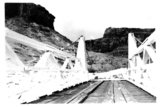
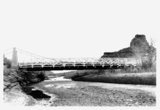
Show NPS Form 10-900-a Utah WordPerfect 5.1 Format (Revised Feb. 1993) United States Department of the Interior National Park Service National Register of Historic Places Continuation Sheet Section No. 8 Page 5 San Rafael Bridge, Emery County, UT camper's paradise" 16 The local high school band performed, speakers pointed out many of the scenic attractions to be found along the new road, and cattlemen furnished barbecued beef and mutton. 17 Engineering Bridges had been constructed across the San Rafael River before, each of the three having been pier bridges where their support substructures had been constructed in the river bed. As flash floods swept through the dry washes they washed away the bridge supports. The solution was to construct a suspension-swing bridge type with its support structure located on the river banks. 18 The San Rafael Bridge is significant in its design and construction. The simplicity of its basic design, the strength of each of its components, and the serviceability of this bridge have made it an excellent example of the application of basic engineering principles in the first half of the twentieth century. Also its straightforward design compliments its wilderness-like setting. The uniqueness of its design is also important as one of only two remaining cable suspension bridges in Utah. Through researching photographs of bridges throughout the state it appears that most of them built during the time period 1935-40 were constructed of concrete. The CCC in Utah The Civilian Conservation Corps was one of the most successful of President Franklin D. Roosevelt's New Deal programs. The CCC was in operation for nine years, 1933-42, providing jobs and training to young men 18-25 years old. The men earned $30 per month, $25 of which was sent home to help support their families, leaving them $5 per month personal spending allowance. Their housing, food, and clothing were provided. Utah had a total of 116 camps, though only 30-40 were in operation at any given time. Each camp had about 200 enrollees. Almost 60 percent of the CCC enrollees in Utah were from out of state; the remainder were local boys. Some of the out-of-state boys married local girls and stayed in Utah. The camps were sponsored by a federal or state agency, which outlined projects and oversaw their completion. In Utah, the Forest Service had the most camps with 47, followed by the Division of Grazing (now the BLM) with 24. 19 "Dedication Program and Plans Ready for Bridge Celebration", Emery County Progress, April 23, 1937. 17 Ibid. 18 Historic American Engineering Record, UT-60, 1990, p.6. On file at Utah State Historic Preservation Office. 19Compiled from Kenneth W. Baldridge, "Nine Years of Achievement: The Civilian Conservation Corps in Utah," (PhD. dissertation, Brigham Young University, 1971). X See continuation sheet |