| OCR Text |
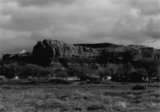
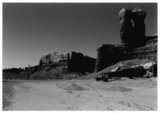
Show NPS Form 10-900-a Utah WordPerfect 5.1 Format (Revised Feb. 1993) United States Department of the Interior National Park Service National Register of Historic Places Continuation Sheet Section NO. 10 Page 13 Bluff Historic District, Bluff, San Juan County, UT Verbal Boundary Description The boundary of the Bluff Historic District is shown on the accompanying USCS map and the more detailed Bluff Historic District Map. The following description further clarifies the boundary. Beginning at the northeast corner of the intersection of Main Street (U.S. Highway 191) and 4th East Street, proceed east along the north side of the road, following it as it bends northeasterly, to the intersection of the highway with Navajo Twins Drive. Then proceed westerly along the south side of Navajo Twins Drive approximately 500 feet. Then proceed north approximately 900 feet, passing just to the east of the Navajo Twin Rocks, a natural formation. Then proceed east approximately 1300 feet to a point on the northern/western boundary of the Highway 191 right-of-way which is also the southern point of the mouth of the draw where "The Ballroom" is located. Then proceed northeasterly along the highway right-of-way line approximately 400 feet to the northern point of the mouth of the draw where "The Ballroom" is located. Then proceed north approximately 600 feet to the northern boundary line of the San Juan Service Area #1 (Bluff), which line is also the northern boundary of the south one-half of the southwest one-quarter of Section 19, Township 40 South, Range 22 East, Salt Lake Base and Meridian. Proceed west along this quarter-quarter section line approximately 4300 feet to a point intersected by the north/south-running UTM "easting" line 62800, which point is at the western base of the bluffs. Then proceed in a southwesterly direction approximately 1500 feet, passing to the west of Locomotive Rock, to a point that intersects the section line. Then proceed south approximately 600 feet to the western-most extension of Cemetery Road. Proceed along the southern boundary of Cemetery Road, following it east as it becomes Mulberry Avenue approximately 300 feet. Then proceed south behind the Decker House approximately 500 feet to the south side of Black Locust Avenue (if extended to the west beyond 3rd East Street). Then proceed east approximately 750 feet to the southeast corner of the intersection of Black Locust Avenue and 4th East Street. Then proceed south approximately 500 feet to the beginning. Boundary justification The boundary includes all of the remaining historic buildings and structures in Bluff as well as surrounding natural features that have cultural significance. Irregularities in the boundary, specifically along the western and eastern sides, reflect the attempt to exclude non-historic buildings on the edges of the district. More non-historic buildings could possibly have been excluded from the district by using more radical zigzagging, but the result would have been a much more confusing district boundary and the loss of some non-building features that contribute to the overall historic character of the town, such as fences and open spaces (fields, vacant lots, etc.). The inclusion of the bluffs north of town, as justified in sections 7 & 8, raised the question of how much of the bluffs to include. The existing boundary of the town's special service area provided a well-defined line that seemed reasonable for the resources, allowing more than just the vertical face of the bluffs to be included and incorporating a reasonable section of Calf Canyon to also be included. Extending the northern boundary to include all of Calf Canyon and all of the sandstone bluffs seemed excessive. The jog in the eastern boundary is probably the most controversial. After following Highway 191 for a ways, the boundary cuts back to the west then proceeds north several hundred feet before jogging back to the east and rejoining the highway. The purpose in this jog was to keep in the district the very prominent and historic Navajo Twin Rocks and Ballroom while excluding non-historic structures in this area. These include new buildings on the north side of Navajo Twins Drive and along the west side of Highway 191 and Highway 191 itself, an overwhelmingly dominant non-contributing structure in the otherwise historic Cow Canyon. The boundary could perhaps have been drawn to follow the contour of the bluffs, thereby excluding the buildings and highway, but the squared-off boundary that was chosen had gained local approval and did not compromise the district, so it was retained. |