| OCR Text |
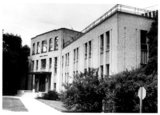
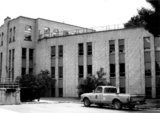
Show Street Address:_________________________________________Site No: Architect/ Builder: p? o LU o cc Joseph Don Carlos Young jr. & Ramm Hansen/Frank Campion Building Materials: masonry Building Type/Style: pWA Mod erne Description of physical appearance & significant architectural features: (Include additions, alterations, ancillary structures, and landscaping if applicable) The Women's Residence Hall at Utah State University, built in 1936-37, is a good example of the PWA Moderne architectural style in Utah. The building is constructed of yellow brick in the shape of an open "V" and in the middle, where the 2-story wings intersect, there is a large 3-story block containing the main entrance. Facing out onto an open courtyard, this centrally-located section dominates the building and becomes the focal point of the design. In keeping with the spirit of the classically-oriented PWA Moderne style, the general appearance of the building is crisply geometric the corners are sharp, the roof is flat, and the windows are broken up into long, narrow panels. There is a band of dark brown concrete coping and a stylized geometric railing along the edge of the roof that serve to emphasize the horizontal massing of the building. Within this basic structure, however, the accent is on vertical ity. The window panels appear as brown strips of color against the neutral yellow surface. Metal spandrels are found beneath the windows and the bricks above each window panel are laid vertically in order to visually continue the upward movement of the panels. The central entrance block is distinguished by a slightly stepped parapet and round decorative medallions above the upper story brick mull ions. The corners of this section are corbeled and the upper windows have half-octagonal heads. The building remains in good original condition. (Continued on next page.) g >. o w 1 Statement of Historical Significance: Construction Date:1936-37 Built in 1936-37, the Women's Residence Hall at Utah State University is part of the Public Works Buildings Thematic Resource nomination and is significant because it helps document the impact of New Deal programs in Utah, which was one of the states that the Great Depression of the 1930s most severely affected. In 1933 Utah had an unemployment rate of 36 percent, the fourth highest in the country, and for the period 1932-1940 Utah's unemployment rate averaged 25 percent. Because the depression hit Utah so hard, federal programs were extensive in the state. Overall, per capita federal spending in Utah during the 1930s was 9th among the 48 states, and the percentage of workers on federal work projects was far above the national average. Building programs were of great importance. During the 1930s virtually every public building constructed in Utah, including county courthouses, city halls, fire stations, national guard armories, public school buildings, and a variety of others, were built under federal programs by one of several agencies, including the Civil Works Administration (CWA), the Federal Emergency Relief Administration (FERA), the National Youth Administration (MYA), the Works Progress Administration (WPA), or the Public Works Administration (PWA), and almost without exception none of the buildings would have been built when they were without the assistance of the federal government. The Women's Residence Hall at Utah State University is one of 232 buildings constructed in Utah during the 1930s and early 1940s under the Works Progress Administration (WPA) and other New Deal programs. Of those 232 buildings, 133 are still standing and retain their integrity. Of the 232 buildings, 19 were constructed on college and university campuses; 13 of them remain. In Cache County a total of 18 buildings were constructed, 13 of which remain and are well preserved. Of the 18 originally built, 5 were built on the campus of the Utah State Agricultural College, now Utah State University; all of those still remain. |