| OCR Text |
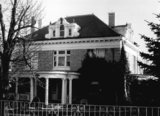
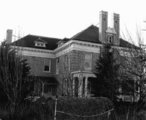
Show 7. Description Condition X excellent qood fair deteriorated ruins unexposed Check one unaltered X altered Check one x original site moved datP Describe the present and original (iff known) physical appearance Built in 1900, the Thomas R. Cutler Mansion is a two story box designed in the Colonial Revival style. It is a brick house which was stuccoed and the plaster scored to resemble stone. It has a low hip roof with three part classically decorated dormers projecting from the north and west roof sections, and a swan's neck pedimental dormer projecting from the east roof section. A pair of impressive chimneys frame the east dormer. They are very tall, have inset panels, and have bands of simple classical moldings near the top. The other two chimneys, located behind the west dormer and at the south gable end, are simpler, and are also topped with bands of classical moldings. There is an original two story extension attached perpendicular to the rear of the house. Because the extension is attached fairly close to the west wall of the original section, the house and its extension has an L-plan. A porch which begins at the main entrance on the north facade, spans the east side of the north facade, wraps around the northeast corner of the building, and spans the entire width of the east side of the building. It is composed of classical revival elements. The section of porch over the entrance resembles a portico, consisting of a semi-circular projection off the front of the porch. The porch has a flat roof, is supported on Tuscan columns, has a broad entablature with a boxed cornice, and has a balustrade of lathe-turned balusters. Decorative posts with inset panels are attached to the ends of segments of the balustrade and frame the bases of many of the columns. A three part bay projects from the west side of the building. It has a pair of double hung sash windows in the center section, and a single window of the same type in each of the side panels. The broad entablature of the bay extends beyond the bay to cap a porch attached to the west side of the rear extension. The porch was enclosed, but that change is unobtrusive. The facade is symmetrical with a tripartite configuration of openings. The door is centered on the facade, and is flanked by broad single pane windows with transoms. The entrance opening is divided into three sections, consisting of a door centered between two panels of side lights. The transom section above the door and side lights has also been divided into three parts. A three part bay window is centered over the main entrance, and is flanked on each side by pairs of double hung sash windows. The bay window has a large single pane window centered between small double hung sash windows. Again, the transom section was divided into three sections which correspond with the three window sections. Most of the other windows of the main section of the house are the one double hung sash type, and all of the double hung one over one windows have decorative stickwork on the upper sashes. There is a window with a semi-circular transom in the south wall. Simple two double hung sash windows were used on the rear extension. one over light large over two The Cutler House reflects the Colonial Revival style at the turn of the century in its symmetrical facade and classical detailing. Classical elements include: the broad entablature with a boxed cornice; the dentils on the frieze; the ornate classically decorated dormers; the decorative quoins; and the classical porch that wraps around the northeast corner of the house. |