| OCR Text |
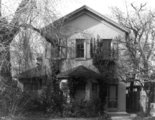
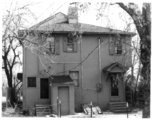
Show 7. Description Condition excellent _)t_good fair deteriorated ruins unexposed Check one unaltered X altered Chc(ck one ^ original site date moved by 1930 » specific dates not known Describe the present and original (if known) physical appearance The Rumel House is two stories high, constructed of brick covered with stucco, and was built in 1887. It is a temple-form vernacular house type with a side passageway plan. As originally built the house consisted of one long rectangular block with a gable roof, and was oriented gable end to the street. A small one story brick addition was made to the rear by 1898, and a bay window and a narrow one story addition to the south side were added by 1958. In its most common form, the Greek Revival temple-form house was found with its gable end facing the street with the main entrance pushed to one sideJ This arrangement allowed there to be one large room, usually the parlor, in the front of the house, flanked by a small side passageway containing a staircase. Common in New England and along the westward moving New England frontier of the upper Midwest, the temple-form house appeared in Utah from the days of first settlement by the members of The Church of Jesus Christ of the Latter-day Saints. Because wood was not abundant in Utah, what was predominantly a frame type in the East often appeared as an adobe or brick house covered with stucco, giving it the smooth, light finish characteristic of Greek Revival designs. Classical elements, in most cases, were limited to occasional accents along the cornice or at the main entrance, but it was quite common to eliminate decorative elements altogether, and to finish the roof edge with a smooth cornice. The Rumel house, a late rendering of the adaptation of the Greek Revival temple-form in Utah, is a good example of the archetypal, gable facade, side passageway house type. Its side passageway plan is easily read in the balanced arrangement of openings of the facade with the entrance to one side flanked by a bay window. There are three window openings on the second story. The bay window may not be original, and it is likely that in its place there originally existed two windows which were aligned with those on the second story. The stucco sheathing over the brick walls may have been original, or it may have been added at a later date to protect the brick. Decorative elements do not exist, the cornice having been reduced to a simple band, and the window and door openings simply cut into the wall without accent. The second story windows are the two over two light, double hung sash type, typical of the period in which the house was built. Major alterations have been made to the house, but the basic form is intact and easily identifiable. Alterations include the addition of shutters to the second story windows, the bay window, the narrow one room addition on the south side which is set back fom the facade and therefore unobtrusive, and the brick addition to the rear of the house which was enlarged from one story to two stories by 1958. The house was divided into apartments by 1930 indicating that alterations to the interior have been made. Despite these alterations the integrity of the original house has been preserved. Notes 'William H. Pierson, Jr., American Buildings and Their Architects: The Colonial and Neoclassical Styles, (Garden City, New York:Anchor Press, Doubleday, 1976), p. 450. |