| OCR Text |
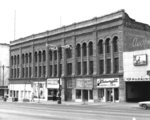
Show Street Address: 2.60 South State______________________;____Site No: Architect/Builder: Samuel C. Dallas and V/illiam S, Hedges Building Materials: Brick and Sandstone______________________________ Building Type/Style: Richardsonian Romanesque Description of physical appearance & significant architectural features: (Include additions, alterations, ancillary structures, and landscaping if applicable) Brooks Arcade is oneof Utah 1 s finest examples of Richardsonian Romanesque architecture, a. style which became popular in the state 1 s commercial building; erected during the "building boom" of 1889-1893. Intended to be six stories high, the building apparently began to sink under the weight of its brick and stone superstructure and only three stories were completed. Built on a corner, the two front exterior elevations display the heavy massing, Roman arches, and. active surface texture typical of Richardsonian Romanesque styling. Dallas and Hedges, thearchitects, were prominent designers in the state from the mid 1880s untilthe early 1900s. They are best known for the Alfred McCune Mansion (NR), Utah 1 s largest most prestigious residence. Brooks Arcade is a three-story retail store and office building. Its superstructure is brick while the two walls facing Main Street are veneered with gray-brown Kyune sandstone. The building occupies a. corner lot and has a pent corner. In plan the building is rectangular, being about twice as long as it is wide. It has a. flat roof and is divided vertically into several units which, in the first floor, consist of small retail shops and in the two upper floors contain various professional offices. The exterior of the Brooks Arcade is architecturally interesting as an example of Richardsonian Romanesque styling. The upper two floors are particularly characteristic of the round, arched., highly textured, heavily fy £ 8 | Statement of Historical Significance: Construction Date: 1891 Brooks Arcade is significant for its association . with prominent Utah merchant and investor, J. G. Brooks, the first Jew to settle in Utah. The building is also significant as one of Utah's best extant examples of Richardsonian Romanesque architecture. The Brooks Arcade was built in 1891 for Julius Gerson Brooks, a prominent Salt Lake City merchant and real estate investor. He and his wife Fanny were the first Jews to settle permanently inSa.lt Lake City, coming to the city in 1854* The Brooks (or Brucks) family came from Silesia. Born in ISSI, Julius left Germany at the'age of 21, took passage to New York City, lived for a. time with a sister and, according to Historian Leon Y/atters, "peddled in New England." Like some immigrants of the period, he earned a modest sum, returned to Silesia, and took a bride of 16 years back to the United States. Fascinated bytales of the Far West, the couple headed for Oregon by way of Utah. Arriving in the Salt Lake Valley in"July 1854 they decided to stay, and as historian Juanita Brooks notes, became "solid citizen; of the business, religious, andsocial community." Stimulated by the ebullience of Utah 1 s economy in the late 1880s arid e?rly 1890s Brooks made plans to construct a large, six-story business block,, As the building was being constructed between 1890 and 1891, however, the first tremors of the Depression of 1893, which was to be the worst economic crisis in the United States to that time, were felt andthe work on the building was terminated at the three-story stage. Following its completion, the Brooks Arcade was occupied by a. variety of small business and professional.offices typical of the period. Occulists, violin teachers, dentists, printers, and. milliners all plied their trades ;u>. the building. One tenant cf -significance was the lit ah Ko r r e spon d on t en, a :;v.ed.:l8h language v/eekly established by Otto Rydman in 1890. Originally as an. organ of the Mormon Church, the Utah Ko r r e spp n d en t en quickly into something quite different, explicitly setting for itself two |