| OCR Text |
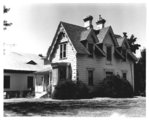
Show 8. Significance Period prehistoric 1400-1499 1500-1599 1600-1699 1700-1799 _X_ 1800-1 899 1900- Specific dates Areas of Significance Check and justify below archeology-prehistoric community planning archeology-historic agriculture _X_ architecture ^rt commerce communications conservation economics education engineering exploration/settlement industry invention landscape architecture law literature military music philosophy politics/government religion science sculpture social/ humanitarian theater transportation other (specify) c< 1884 Statement of Significance (in one paragraph) The George M. Brown House in Provo, built in 1884, is the best example of the wooden Carpenter's Gothic architectural style in Provo and one of only several examples of the style in Utah. 1 Inspired by the pattern books of the mid nineteenth century, particularly the published works of A. J. Davis and A. J. Downing, the Carpenter Gothic was characterized by local interpretation of picturesque designs, often approximating a regional vernacular.2 The Brown house exhibits the verticality and decorative jigsaw work usually found in the Gothic Revival, but displays the horizontal siding, simulated quoins, and symmetry of the local building tradition. The house belonged to George M. Brown, an early settler and prominent lawyer in Provo, and was identified in a comprehensive architectural survey of Provo during the summer of 1980. George M. Brown had this house built for a polygamous wife in the early 1880s. Brown was a prominent early Provo attorney who was born in Macedonia, Illinois in 1842. His parents had earlier converted to Mormonism and the family moved west with the pioneers in 1847. They settled in Provo. After completing an LDS mission to Norway, Brown returned to Provo and married Elizabeth 01 sen. He then studied law and established a legal practice in Provo. From 1875 to 1888, Brown was involved in a legal practice with John E. Booth, another prominent Provoan. In the 1880s Brown gave this house to his first wife and moved to the Mormon colonies in Mexico with his other two wives to avoid prosecution for polygamy. Elizabeth Brown lived in the house apparently until her death when her daughters inherited the house. They resided in the house for several decades. In 1958 Don R. Milner bought the house from the estate of Li Hie Brown, one of the daughters of George M. Brown. The house is still owned by the Milner family who use it as rental property. Notes Peter L. Goss, "The Architectural history of Utah," Utah Historical Quarterly 43:3 (Summer 1975), p. 219. Other Utah examples include the William Barton House, Avenues Historic District, National Register; the Thomas Quayle House, Capitol Hill Historic District, National Register; and the Watkins-Coleman House, Midway, National Register. 2The Carpenter Gothic concept is defined in William * I. Pierson, Jr., American Buildings and Their Architects: Technology and the Picturesque (Garden City, N.Y.: Doubleday, 1978), p. 41 (T |