| OCR Text |
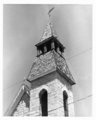
Show Form No 10-300a (Rev. 10-74) UNITED STATES DEPARTMENT OF THE INTERIOR NATIONAL PARK SERVICE NATIONAL REGISTER OF HISTORIC PLACES INVENTORY » NOMINATION FORM CONTINUATION SHEET ITEM NUMBER 7 PAGE 2 approach in the period; consulting architectural patternbooks then collaborating with the mason and the carpenters to develop the design. The well proportioned result is today almost unaltered. The church has a wood-shingled gable roof. It is pierced by two centrally located chimneys of yellow brick, one at the ridgepole and the other along the east wall. A wooden cornice built up of molding runs under the eaves. The front gable end has a turned wooden finial rising above the peak of the roof, and simple scroll-sawn bargeboards. The stone walls are laid in rough-faced coursed ashlar bond with courses of random width. Window and door openings have pointed Gothic arches of stone. On both the north and south sides of the church there are three double-hung windows with Gothic-arched upper sash. The front (west) facade has a large central window with simple wooden tracery. It is flanked by a pair of panelled wood doors with arched transom windows. The west door of the pair is in the tower, an interesting contrast of the symmetry of the openings against the asymetry of the building's massing. The two-story stone tower has the panelled wood front door at the first story level, and a pair of Gothic arch openings at the second story. Located on the west and south sides of the tower they probably originally contained windows but are now open, allowing glimpses of the ladder to the belfry above. The wooden belfry has three parts. The base is a steep-sided truncated pyramid covered by wood shingles. The next section, which still contains the bell, is open. It consists of wooden arches resting on eight simple rectangular columns, with a strip of molding at the top of each column. This is topped by a tall, steep, flaired hip roof covered with wood shingles. The distinctive column-moIding-and-arch design of the bell house section, its flared roof, and also a portion of the base are repeated on the simpler Presbyterian churches at Gunnison, Salina, and Monroe. These three were all built in 1884, after the Manti church has been completed. The Richfield Church, 1889, may have had a similar belfry before it was rebuilt in 1937. The common design elements provide a visual unity between the early Presbyterian churches, and may indicate that all were the work of designer Peter Van Houghten or of the craftsmen the Jenson Brothers and Mathias Andreason. |