| Title |
Ray E. Brim, Salt Lake City, Utah: an interview by Winston P. Erickson, June 25, 2001: Saving the legacy tape no. 109 |
| Alternative Title |
Ray E. Brim, Saving the legacy: an oral history of Utah's World War II veterans, ACCN 2070, American West Center, University of Utah |
| Creator |
Brim, Ray E., 1922- |
| Contributor |
Erickson, Winston P., 1943-; University of Utah. American West Center |
| Publisher |
Digitized by J. Willard Marriott Library, University of Utah |
| Date |
2001-06-25 |
| Date Digital |
2015-09-16 |
| Access Rights |
I acknowledge and agree that all information I obtain as a result of accessing any oral history provided by the University of Utah's Marriott Library shall be used only for historical or scholarly or academic research purposes, and not for commercial purposes. I understand that any other use of the materials is not authorized by the University of Utah and may exceed the scope of permission granted to the University of Utah by the interviewer or interviewee. I may request permission for other uses, in writing to Special Collections at the Marriott Library, which the University of Utah may choose grant, in its sole discretion. I agree to defend, indemnify and hold the University of Utah and its Marriott Library harmless for and against any actions or claims that relate to my improper use of materials provided by the University of Utah. |
| Spatial Coverage |
Dividend, Utah County, Utah, United States; Germany; London, England, United Kingdom |
| Subject |
Brim, Ray E., 1922- --Interviews; World War, 1939-1945--Personal narratives, American; World War, 1939-1945--Aerial operations, American; Veterans--Utah--Biography |
| Keywords |
Mining towns; Pearl Harbor; Military aircraft; Pilot training; B-17; England; Bovingdon; 92nd Bomb Group; 482nd Bomb Group; Pathfinders; 100th Bomb Group; Air Force; Korea |
| Description |
Transcript (36 pages) of interview by Winston P. Erickson with Ray E. Brim on June 25, 2001. This is tape number 109 in the "Saving the Legacy" Oral History Project |
| Collection Number and Name |
Accn2070, Saving the Legacy oral history project, 2001-2010 |
| Abstract |
Brim (b. 1922) volunteered for the Army Air Corps shortly after the attack on Pearl Harbor. After eight months of training he was assigned to Paine Field, near Seattle, Washington, where he flew P-39 aircraft. He recalls training on B-17s and his experiences in Africa and England. Brim remained in the service and retired as a colonel in 1975. 36 pages. |
| Type |
Text |
| Genre |
oral histories (literary works) |
| Format |
application/pdf |
| Extent |
36 pages |
| Language |
eng |
| Rights |
 |
| Scanning Technician |
Mazi Rakhsha |
| Conversion Specifications |
Original scanned with Kirtas 2400 and saved as 400 ppi uncompressed TIFF. PDF generated by Adobe Acrobat Pro X for CONTENTdm display |
| ARK |
ark:/87278/s6612zj7 |
| Topic |
Personal narratives--American; Veterans; World War (1939-1945); Military operations, Aerial--American |
| Setname |
uum_slohp |
| ID |
1020633 |
| Reference URL |
https://collections.lib.utah.edu/ark:/87278/s6612zj7 |
| Title |
Page 17 |
| Format |
application/pdf |
| Setname |
uum_slohp |
| ID |
1020611 |
| OCR Text |
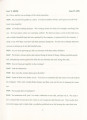
Show RAY E. BRIM June 25, 2001 the process of moving from Williams over to Santa Ana, again by train, they lost our medical records. So we had to go through all the shots again. And it didn't seem to bother them. So you've had them, there is no record, we will give them to you again. WIN: Make a new record. RAY: Yes, make a new record. WIN: Did they have you fly at all at Williams? RAY: No. No flying until later Santa Ana was a pre-flight program. So, again, ground schools marching and testing. I left there and went to Rankin Academy, which Is at Tulare, California for my pnmary training. WIN: What kind of planes? Were they Stearmans? RAY: Stearmans, PT-17s. WIN: Open cockpit? RAY: Open cockpit. You would communicate with a funnel, with rubber tubes going to your ears onto the helmet. Then you would talk Into a funnel to the man sitting behind, or in front, of you. I struggled. I had a difficult time learning to fly Landing the airplane seemed to be my nemesis. WIN: That's the hardest part of flying, Isn't it? You can get up, and you can fly around, but getting down is tough. RAY: Getting back down in one piece was. And I had a couple of check ndes to see If I was going to make It. But, somehow, I got things together for a check nde and I passed. After I got through the onginal training-I would say the first fifteen or twenty hours of training- then it was a 15 |
| Reference URL |
https://collections.lib.utah.edu/ark:/87278/s6612zj7/1020611 |