| Title |
Walter Stewart, Benjamin, Utah: an interview by Winston P. Erickson, May 25, 2000: Saving the legacy tape no. 21 and 22 |
| Alternative Title |
Walter Stewart, Saving the legacy: an oral history of Utah's World War II veterans, ACCN 2070, American West Center, University of Utah |
| Creator |
Stewart, Walter T., 1917- |
| Contributor |
Erickson, Winston P., 1943-; University of Utah. American West Center |
| Publisher |
Digitized by J. Willard Marriott Library, University of Utah |
| Date |
2000-05-25 |
| Date Digital |
2015-09-16 |
| Access Rights |
I acknowledge and agree that all information I obtain as a result of accessing any oral history provided by the University of Utah's Marriott Library shall be used only for historical or scholarly or academic research purposes, and not for commercial purposes. I understand that any other use of the materials is not authorized by the University of Utah and may exceed the scope of permission granted to the University of Utah by the interviewer or interviewee. I may request permission for other uses, in writing to Special Collections at the Marriott Library, which the University of Utah may choose grant, in its sole discretion. I agree to defend, indemnify and hold the University of Utah and its Marriott Library harmless for and against any actions or claims that relate to my improper use of materials provided by the University of Utah. |
| Spatial Coverage |
Romania; Payson, Utah County, Utah, United States |
| Subject |
Stewart, Walter T., 1917- --Interviews; World War, 1939-1945--Personal narratives, American; Veterans--Utah--Biography; World War, 1939-1945--Aerial operations, American; World War, 1939-1945--Campaigns--Europe, Eastern |
| Keywords |
Ploesti; Oil refineries; Bombing; ROTC. Army Air Corps; 8th Air Force, 93rd Bomb Group |
| Description |
Transcript (61 pages) of an interview by Winston P. Erickson with Walter Stewart on May 25, 2000. This is from tape numbers 21 and 22 in the "Saving the Legacy Oral History Project |
| Collection Number and Name |
Accn2070, Saving the Legacy oral history project, 2001-2010 |
| Abstract |
Walter Stewart (b. 1917) talks about his ancestors being early settlers of Payson, Utah, and discusses raising and selling racehorses. Other topics covered include the Depression, his LDS mission to Scotland, and ROTC. He enlisted in the Army Air Corps and was assigned to the 8th Air Force, 93rd Bomb Group. He speaks at length about his combat missions, the Ploesti raid, piloting the "Utah Man," the rescue of downed crew members, touring the United States on a morale-building assignment, and his post-war reserve duty. 61 pages. |
| Type |
Text |
| Genre |
oral histories (literary works) |
| Format |
application/pdf |
| Extent |
61 pages |
| Language |
eng |
| Rights |
 |
| Scanning Technician |
Mazi Rakhsha |
| Conversion Specifications |
Original scanned with Kirtas 2400 and saved as 400 ppi uncompressed TIFF. PDF generated by Adobe Acrobat Pro X for CONTENTdm display |
| ARK |
ark:/87278/s63f6nwq |
| Topic |
Personal narratives--American; Veterans; World War (1939-1945); Military operations, Aerial--American |
| Setname |
uum_slohp |
| ID |
1019033 |
| Reference URL |
https://collections.lib.utah.edu/ark:/87278/s63f6nwq |
| Title |
Page 41 |
| Format |
application/pdf |
| Setname |
uum_slohp |
| ID |
1019011 |
| OCR Text |
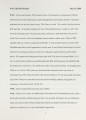
Show W LTER TEW ART a 2 200 out dashing about on the sand. There's a lot of the story I can't tell but when I wa in th Boy Scouts in 1932 the army gave surplus things to Boy Scout troops. And our troop got canteens and mess kits. Other troops got tents, and we were mad. When I went into the service I took my canteen. When they offered me one I said, "Oh, I've got my own." It was a World War I type with a steel lid. Well, we filled my canteen clear up. I said, "I'll volunteer my canteen for this cause." So we filled only two canteens and threw them over to these guys. That's all the water we had. After they were rescued one man said, "Who had the canteen with a steel lid?" I said, "That was mine." He said, "It did not break. The other one with the plastic lid broke and we didn't have any water in it. This saved our lives." After we found those two we started to circle. You go in ever increasing circles and climb up to about eight thousand. Then, to our great joy, we saw a parachute on the lava. The parachute was laid out in the black lava. A white parachute with black lava rocks holding it like an arrow with the shroud lines acting as the shaft, and the chute like an arrow. They've shown us the way they went. We flew right over that line about two miles and there they were with another parachute made into a tent. It was blistering-blistering heat in the day and bitter cold at night. They had a sign written on the rocks with sand, "Four men hurt." One guy out there jumped up, but we had no canteens left for them. Well, many things happened. The British couldn't believe the fact that we found them. They wouldn't believe us. The next day they said, "Nobody was anywhere near where you said." I said, "My navigator and I will go out and fmd them and show you." This time my airplane was ready to go. Roper got in the back. We couldn't 40 |
| Reference URL |
https://collections.lib.utah.edu/ark:/87278/s63f6nwq/1019011 |